Rajan Kumar
Founder, BiodataBuilderRajan built BiodataBuilder to help millions of Indians create professional marriage biodatas easily. With expertise in Indian matrimonial traditions and 2M+ biodatas created on the platform, his guides cover every regional format, community custom, and modern best practice.
Last Updated:
Biodata for Marriage: Create Beautiful Marriage Biodata Online Free
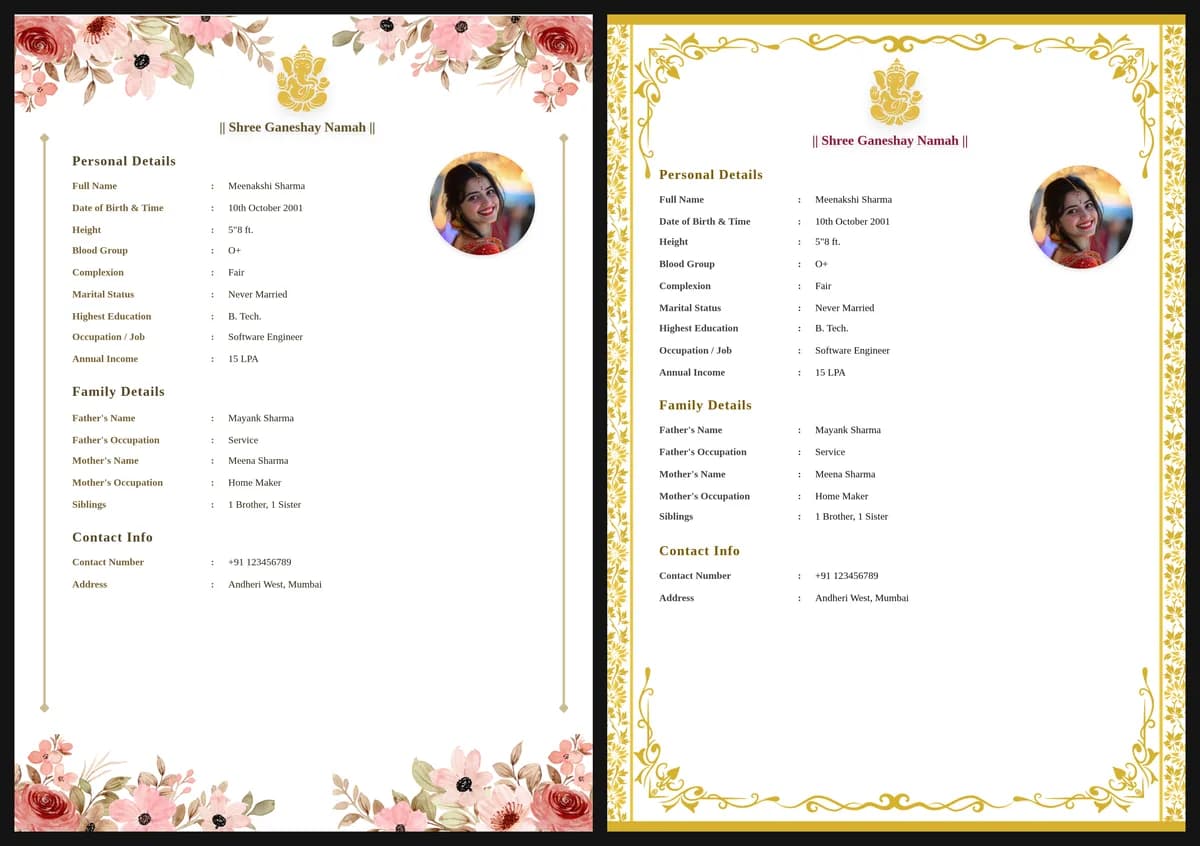
Sample marriage biodata templates created with BiodataBuilder
A marriage biodata — also called a matrimonial biodata or bio data for marriage — is the single most important document in the Indian arranged marriage process. It is your family's first impression to another family.
Whether you are searching for a marriage biodata format for a boy, a shaadi biodata format for a girl, or a simple one-page matrimonial profile to share on WhatsApp — this guide covers everything and shows you how to create one for free in under 5 minutes. For a section-by-section layout with samples, see our biodata format hub.
BiodataBuilder lets you pick from beautiful traditional Indian templates, fill in your details, and instantly download a print-ready marriage biodata PDF — no registration, no watermark, completely free.
What Is a Marriage Biodata?
In Indian culture, a matrimonial biodata format is a structured one-page document that families exchange when exploring potential marriage alliances. Think of it as a structured personal profile — not a resume for jobs, but an introduction for families.
Traditionally, these profiles were handwritten or typed on plain paper and passed between relatives and community matchmakers. Today, they are shared digitally as polished PDFs on WhatsApp, uploaded to matrimony websites, or sent via email.
Why the Format Still Matters in a Digital Age
Some assume that with matrimony websites, apps, and long-form profiles, the traditional one-page biodata might become obsolete. In practice, the opposite has happened. Matrimony platforms often ask users to upload a formatted biodata alongside their online profile, because families still want a portable, printable, shareable document they can forward to relatives, discuss over a phone call, or keep in a folder of ongoing prospects. The biodata has become a companion to digital matchmaking rather than a replacement for it.
Personal Introduction, Not Just Personal Data
Unlike a Western dating profile, an Indian marriage biodata includes not just personal details, but family background, astrological information, and community roots — because in arranged marriages, a family is choosing for a family, not just one person choosing for themselves. Parents, grandparents, siblings, and sometimes even extended relatives will read this document, so it needs to communicate stability, compatibility, and cultural alignment at a glance. Read our dedicated guide on the difference between a biodata and a resume to understand this more clearly.
Why a Well-Crafted Biodata Makes a Real Difference
It's tempting to think that a biodata is just a formality — that what really matters is the meeting, the conversation, the chemistry. And to a large extent, that's true. But the biodata is the gatekeeper to all of that. Before any conversation happens, someone has to say "yes, let's talk to this family," and that decision is almost always made after reading a biodata.
A few realities worth keeping in mind:
- Families often review dozens of biodatas in a short span, especially through community matchmakers, matrimonial sites, or extended networks. A biodata that is cluttered, hard to read, or visually dated is easy to set aside — even if the person behind it would have been a great match.
- First impressions form in seconds. Long before anyone reads your hobbies or education, they register whether the biodata looks trustworthy and put-together.
- A clean, well-designed biodata signals effort and seriousness, which many families interpret as a proxy for how seriously that person is approaching marriage itself.
- On the other hand, an overly flashy or gimmicky design can undercut a biodata just as much as a sloppy one — the goal is polish, not spectacle.
This is exactly why tools like BiodataBuilder exist: to remove the design burden entirely, so your biodata reads well and looks professional without needing design skills or expensive software.
What Should Be Included in a Marriage Biodata?
A strong wedding biodata format is concise and well-organised. Every field should communicate relevant information quickly. Here are the essential sections:
| Section | Example |
|---|---|
| Full Name | Rahul Sharma |
| Date & Time of Birth | 15 March 1997, 6:30 AM |
| Height | 5′ 10″ |
| Blood Group | B+ |
| Religion / Caste | Hindu, Brahmin |
| Highest Education | MBA — IIM Ahmedabad |
| Occupation | Software Engineer, Infosys |
| Annual Income | ₹18–20 LPA |
| Rashi / Nakshatra | Vrishabha / Rohini |
| Manglik Status | Non-Manglik |
| Hobbies | Travel, Reading, Cricket |
| Family Details | Father: Govt. Officer, Mother: Homemaker, 1 Brother (married) |
| Contact Number | +91 98765 43210 |
Keep the biodata to exactly 1 page. Families receive many profiles — a clean, scannable single page is far more effective than a multi-page document. If you're struggling to fit everything, that's usually a sign to trim optional details (like a lengthy hobbies list) rather than shrink the font size until it becomes unreadable.
Optional but Increasingly Common Fields
Beyond the essentials, many modern biodatas — especially those created online — include a few additional fields that add context without cluttering the page:
- Diet preference (vegetarian, non-vegetarian, eggetarian, vegan)
- Native place / hometown, separate from current city of residence
- Languages known, particularly relevant for cross-regional or NRI matches
- Marital status, if not a first marriage (never married, divorced, widowed)
- A short "About Me" paragraph, usually 3–4 sentences summarising personality and expectations
These fields aren't mandatory, but including one or two of them — particularly diet preference and native place — often answers questions a family would otherwise have to ask separately.
Marriage Biodata Example for Boy
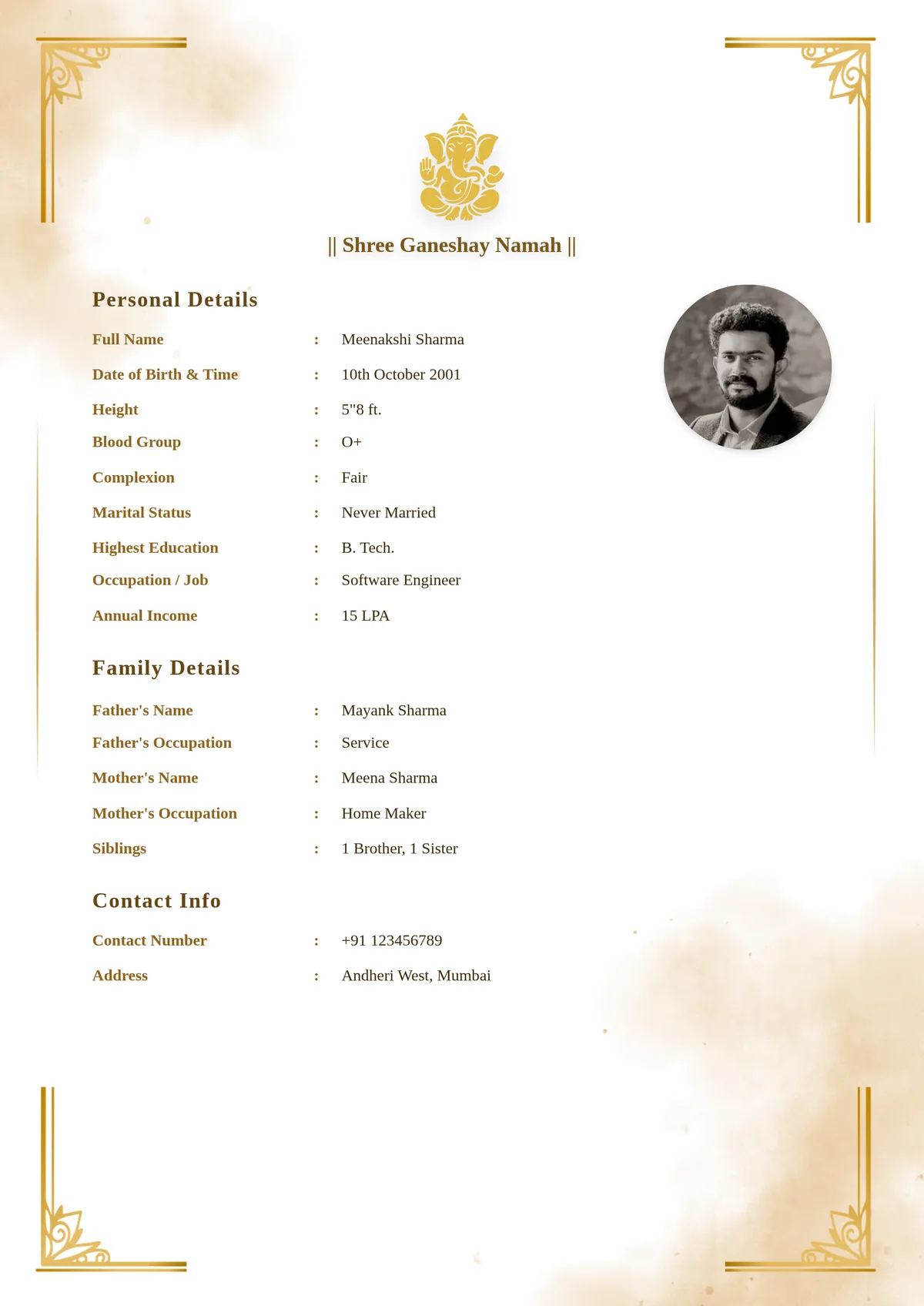
A marriage biodata format for a boy should convey confidence and reliability. The photo should be a clear, recent portrait — not a casual selfie.
- Clean, minimal layout — easy for parents to read quickly
- High-quality photo — portrait style, neutral background
- Profession & income clearly stated
- Family details included — shows stability
- God icon at top — signals cultural alignment
What Families Look for in a Groom's Biodata
Beyond the checklist above, families reviewing a groom's biodata often pay close attention to career trajectory rather than just current salary — an upward path (say, a recent promotion or an ongoing certification) can matter as much as the number on the page. Family structure also plays a role: whether the boy lives with parents, is the sole earning member, or comes from a joint family can shape expectations about the bride's future household role. Being upfront and clear about these details, rather than vague, tends to build more trust than it costs.
Marriage Biodata Example for Girl
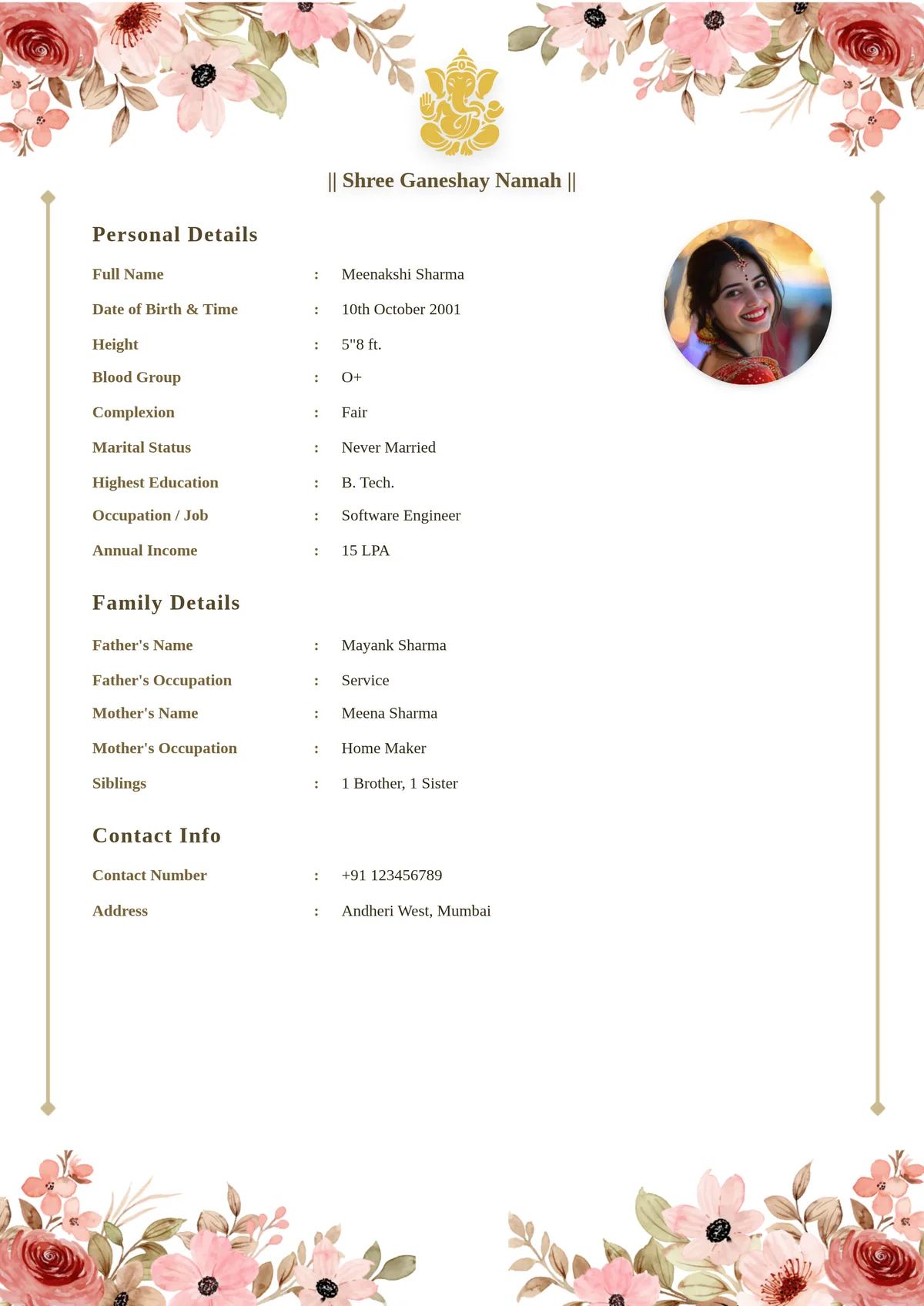
A marriage biodata format for a girl benefits from warm, elegant templates — floral or ornamental designs are very popular. The content structure is identical to a boy's biodata.
- Traditional floral border — a favourite for Hindu families
- Photo framed prominently — circular frame looks polished
- Hobbies & expectations clearly written
- Contact number of a parent is perfectly acceptable
Design Choices That Work Well for a Bride's Biodata
While floral and ornamental themes remain the most popular choice, modern minimal templates are steadily gaining popularity among younger users and urban families who prefer a cleaner aesthetic. There's no single "correct" style — the right choice depends on the family's taste and the community's conventions. What matters more than the specific theme is consistency: the colours, fonts, and spacing should feel cohesive throughout the page, rather than mixing multiple decorative styles that compete with each other.
How to Create a Marriage Biodata Online
You don't need a designer or Microsoft Word. Here's how to create a professional matrimonial biodata in minutes:
Choose a Template
Pick from traditional floral, gold ornate, or modern minimal designs.
Enter Your Details
Fill in personal, family, education, and contact information.
Upload Your Photo
Add a clear portrait and crop it using the built-in tool.
Preview Your Biodata
See exactly how the final PDF will look before downloading.
Download PDF Instantly
Get a pixel-perfect PDF or PNG — ready for WhatsApp or print.
Create Your Biodata in Minutes
Free, beautiful, and ready to share on WhatsApp. No sign-up needed.
Create My Marriage Biodata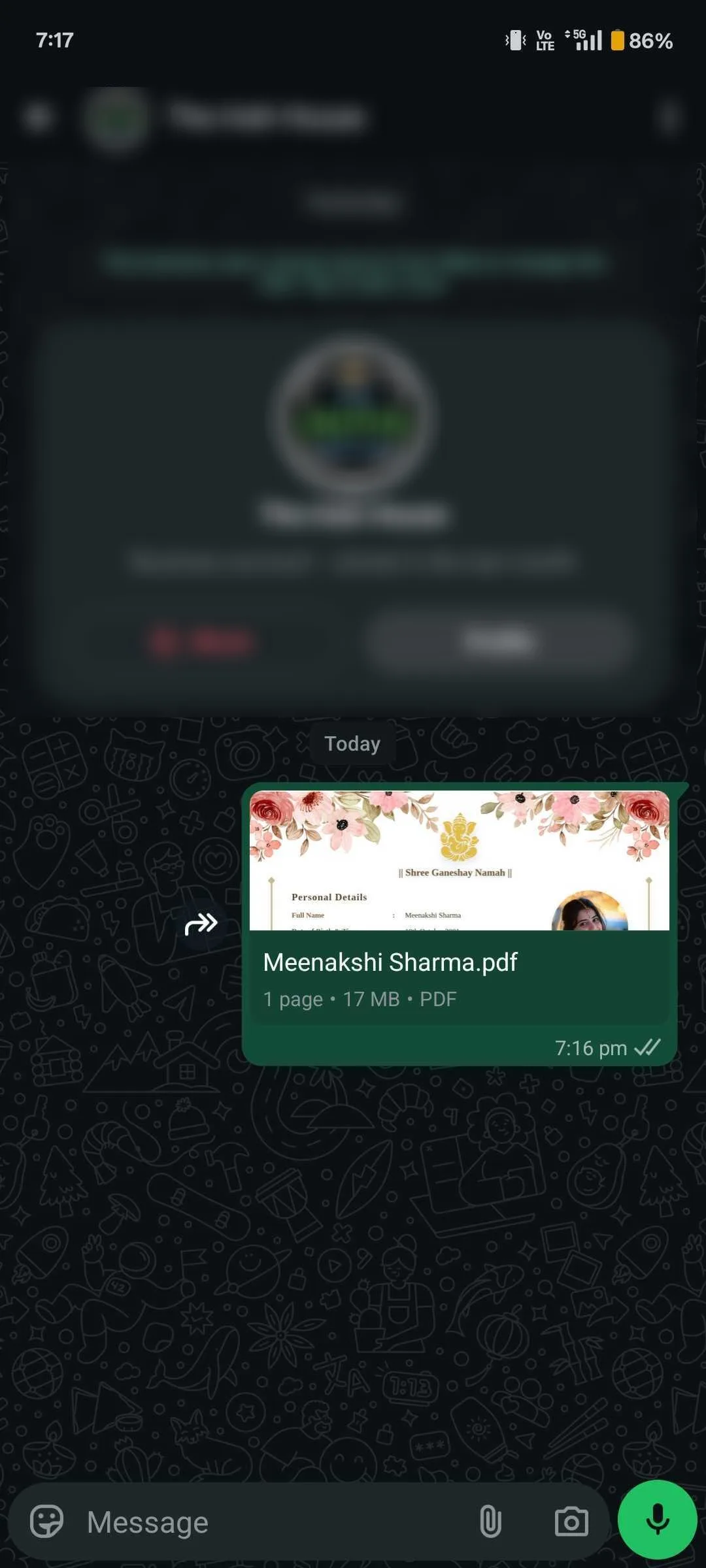
How a BiodataBuilder PDF looks when shared on WhatsApp
Common Marriage Biodata Mistakes to Avoid
A poorly designed bio data for marriage can leave a bad first impression — even if the person is a great match. Avoid these:
- Using a blurry WhatsApp photo — always use a recent, clear portrait taken in good natural light. Photos that have been compressed multiple times through repeated WhatsApp forwarding tend to look pixelated and unprofessional; always attach the original file rather than a forwarded copy.
- Spelling and grammar mistakes — have a family member proofread before sharing. Small errors, like a misspelled qualification or an inconsistent date format, can unintentionally suggest carelessness.
- Overcrowded layout — stick to 1 page. Remove any field that is not essential. If you find yourself shrinking the font size below readability just to fit everything, that's a sign to cut content, not shrink text.
- Sharing as a Word document — Word files break on different phones, especially when fonts aren't embedded. Always share as PDF or PNG, both of which render identically everywhere.
- Using outdated generic templates — a well-designed template signals effort and care, while a template that looks copied from a 2010-era Word file can unintentionally undercut an otherwise strong profile.
- Too much family information — keep family details to parents' names, occupation, and sibling count. Leave the rest for conversation; oversharing (like detailed extended family trees) can make the page feel cluttered without adding real value.
- No photo — biodatas with a clear photo receive significantly more responses than those without, since most families consider a photo a baseline requirement before proceeding further.
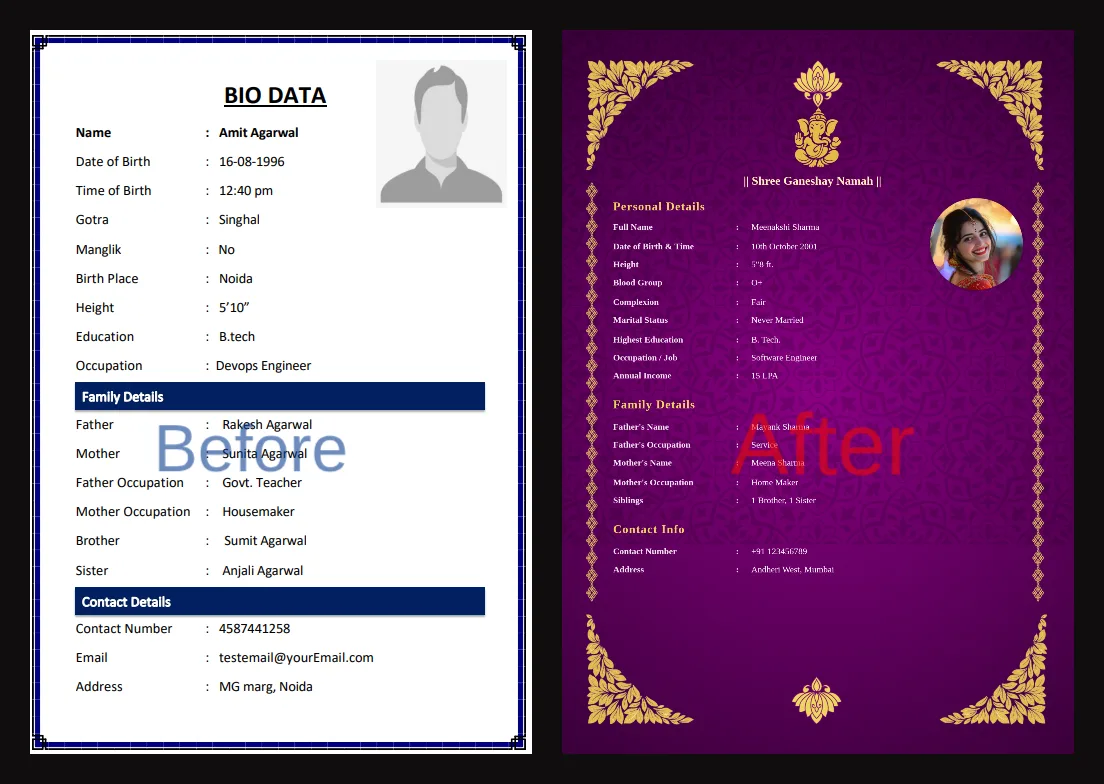
Left: Typical plain Word template. Right: BiodataBuilder PDF output.
A Few More Subtle Mistakes Worth Watching For
Beyond the major issues above, a few smaller details often get overlooked:
- Inconsistent formatting — mixing multiple fonts, font sizes, or bullet styles within the same document looks unpolished even if the content itself is strong.
- Outdated information — a biodata created a year or two ago may still list an old job title, city, or salary. Always double-check that every field reflects your current situation before sharing.
- Missing contact details — it sounds obvious, but it's a surprisingly common oversight, especially when a biodata is copied and edited from an older version.
- Overly casual language in the "About Me" section — while it's fine to show personality, the tone should stay respectful and measured rather than overly informal.
Sharing Your Biodata the Right Way
Creating a great biodata is only half the job — how you share it matters just as much. A beautifully designed PDF can still lose impact if it's shared incorrectly.
- Always share as a PDF, not a Word document or an image screenshot of a Word document. PDFs preserve formatting exactly as designed, regardless of the recipient's device or software.
- Compress large files before sending over WhatsApp, since the platform automatically compresses images and can sometimes reduce quality further if the original file is unnecessarily large.
- Rename the file sensibly — something like
Rahul_Sharma_Biodata.pdfis far more professional than a default filename likeUntitled_Document_1.pdforScan001.pdf. - Avoid sending multiple versions to the same family. If you update your biodata, clearly communicate that the new version replaces the old one to avoid confusion.
- Consider a short accompanying message when sharing, especially through matchmakers or extended family, rather than sending the file with no context.
Biodata Considerations for NRIs and Second Marriages
Not every biodata fits the standard first-marriage template exactly, and it's worth briefly addressing two common variations.
For NRIs (Non-Resident Indians): biodatas often need to include additional context that domestic profiles don't — current country of residence, visa or citizenship status, and plans around whether the couple would settle abroad or return to India. Because time zones and travel logistics play a bigger role in NRI matchmaking, some families also prefer to include preferred contact times or video-call availability.
For second marriages or profiles involving divorced or widowed individuals: honesty and clarity matter more than ever. It's generally advisable to state marital status clearly rather than leave it ambiguous, and to briefly note whether there are children from a previous marriage, since this is a detail most families want to know upfront rather than discover later. A well-designed biodata doesn't need to dwell on the details of a previous marriage — a simple, respectful, factual note is sufficient.
Final Checklist Before You Share Your Biodata
Before hitting send on WhatsApp or forwarding your biodata to a matchmaker, it's worth running through one last review. A few extra minutes here can save you from an easily avoidable mistake:
- Read it out loud once. Awkward phrasing or run-on sentences are much easier to catch when read aloud than when skimmed silently.
- Check every date and number. Date of birth, height, income range, and contact number are the fields most likely to contain a typo, and also the fields families rely on most heavily.
- Confirm the photo is recent. A photo that's several years old can create an unintentionally misleading first impression when the two families eventually meet in person.
- Ask someone outside your immediate family to review it. A friend or cousin who isn't emotionally invested will often spot issues that family members overlook.
- Open the PDF on a different device before sending. This confirms fonts, spacing, and images render correctly outside of the device you created it on.
- Save a backup copy. Keep the original template file or a source copy so you can make quick edits later without starting from scratch.
The Bigger Picture
It's worth remembering that a biodata, however well designed, is still just a starting point — not the whole story. Its job is simply to open a door: to give another family enough confidence and clarity to say "let's take the next step and talk." Everything else — compatibility, values, chemistry — gets discovered afterwards, through conversation and meetings.
That said, a poorly made biodata can close a door that never even had the chance to open. Investing a little extra care into the format, the photo, and the wording isn't about creating a false impression — it's about presenting an accurate, complete picture of yourself as clearly and respectfully as possible. In a process where families are reviewing many profiles in a short amount of time, clarity and polish aren't superficial extras; they're what allow the substance of who you are to actually come through.
Tools like BiodataBuilder exist precisely to remove the friction from that last part — the formatting, the layout, the design — so you can focus on getting the content right and let the template take care of the rest.
Marriage Biodata vs Resume — What's the Difference?
Many people confuse the two or try to submit a modified CV as a biodata. Here is why that never works:
| Marriage Biodata | Resume |
|---|---|
| Used for marriage introductions | Used for job applications |
| Includes family details & astrological info | Focuses on work experience & skills |
| Shared with families & matchmakers | Shared with recruiters & employers |
| 1 page, always | 1–2 pages typically |
| Includes a personal photo | Photo usually not required |
| Includes hobbies & expectations | Includes certifications & achievements |
Regional Marriage Biodata Formats
The matrimonial biodata format varies slightly across communities and languages. BiodataBuilder supports all of them. Click any region below to read the specific guide:
Frequently Asked Questions
What is marriage biodata?
A marriage biodata is a one-page document used in Indian arranged marriages. It includes personal details, family background, education, occupation, and contact info — serving as a family's introduction to another family.
Is marriage biodata necessary?
Yes, in most arranged marriage processes in India, a biodata is the very first step. It helps families make an initial assessment before deciding to arrange a meeting.
How many pages should a marriage biodata be?
Exactly 1 page. Never more than 2. Families receive many profiles — a concise, well-formatted single page is far more effective than a multi-page document.
Can I create a marriage biodata online for free?
Yes! BiodataBuilder.in lets you create, preview, and download a beautiful marriage biodata in PDF or PNG format completely free — no sign-up, no watermark, no hidden fees.
Which photo should I use in my biodata?
Use a recent, clear portrait taken in good natural light. Your face should be clearly visible. Avoid group photos, heavily filtered selfies, or blurry WhatsApp profile pictures.
Should I include my salary in a marriage biodata?
Yes, including your annual income as a range (e.g. ₹12–15 LPA) is generally recommended. It shows transparency and helps families assess compatibility quickly.
What to Read Next
Create Your Marriage Biodata Online for Free
No sign-up. No watermark. Pick a beautiful template, fill in your details, and download a stunning PDF or PNG — ready to share on WhatsApp in under 5 minutes.
Ready to create your biodata?
Use our free builder to make a WhatsApp-ready marriage biodata PDF in minutes.
Open free biodata maker