Rajan Kumar
Founder, BiodataBuilderRajan built BiodataBuilder to help millions of Indians create professional marriage biodatas easily. With expertise in Indian matrimonial traditions and 2M+ biodatas created on the platform, his guides cover every regional format, community custom, and modern best practice.
Last Updated:
Christian Marriage Biodata Format: The Complete Guide
TL;DR - The Quick Summary
- Faith Front and Center: A Christian marriage biodata diverges from other formats by heavily emphasizing Church affiliation, Denomination, and Baptism/Sacrament status.
- Skip the Astrology: Unlike a Hindu biodata, you generally do not need Rashi, Nakshatra, or Gotra, unless your specific regional community (e.g., certain Kerala or Tamil groups) culturally practices it.
- Visual Identity: Including a small cross at the header and a phrase like "By God's Grace" immediately establishes the religious context of the profile.
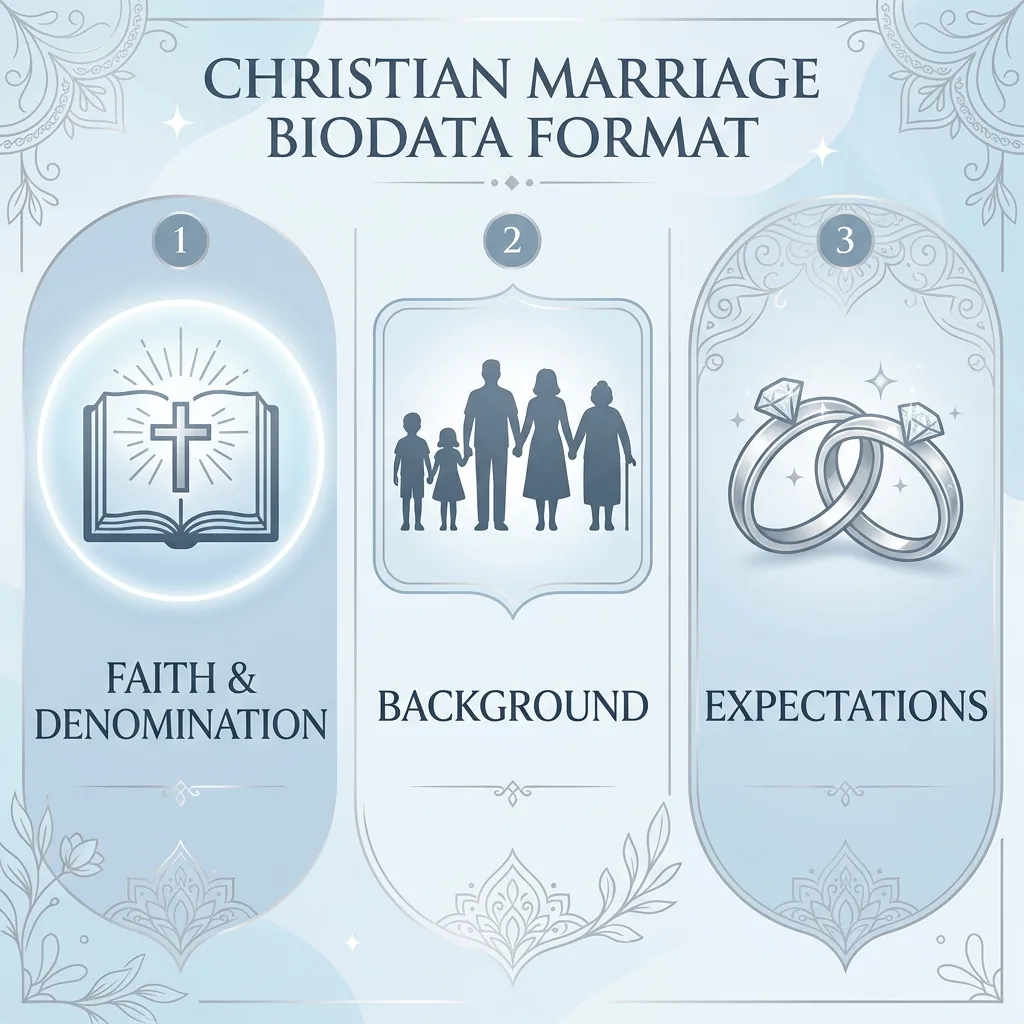
Creating a biodata for marriage is a universal step in the Indian arranged marriage process, but the nuances vary wildly between communities. A Christian marriage biodata is distinctly different from a job resume or a secular profile because faith is not just a background detail—it is the central pillar of the matchmaking criteria.
Whether you belong to the Syro-Malabar Catholic church in Kerala, the Church of South India (CSI) in Tamil Nadu, or an independent Pentecostal church in Mumbai, families will look at your church affiliation before they even look at your career. In fact, according to recent biodata statistics, denominational matching remains the #1 filter for Indian Christian families, often outweighing language and geography.
2. The 6 Core Sections You Must Include
A standard secular biodata won't cut it. You need specific religious fields. Here is exactly what you should map out when formatting your biodata document:
| Section Heading | Fields to Include | Why It Matters |
|---|---|---|
| Header / Invocation | Cross icon + "By God's Grace" or "To God Be the Glory" | Immediately sets a respectful, spiritual tone for the families reviewing it. |
| Personal Details | Full Name, Date of Birth, Height, Complexion, Blood Group | The standard physical and demographic baseline required across all Indian communities. |
| Religious Background | Denomination, Parish/Church Name, Baptism Status, Confirmation Status | The most critical section. Determines if a wedding ceremony is canonically possible in the home church. |
| Education & Career | Highest Degree, University, Current Designation, Company, Location, Salary | Establishes financial stability and intellectual compatibility. |
| Family Details | Father's Name & Occupation, Mother's Name, Siblings (Married/Unmarried) | Shows the family's social standing. (Tip: Mention if a sibling is married into a different denomination). |
| Contact Info | Primary Mobile, WhatsApp Number, Email Address, Residential Address | Always specify if the number belongs to the candidate or the parents. |
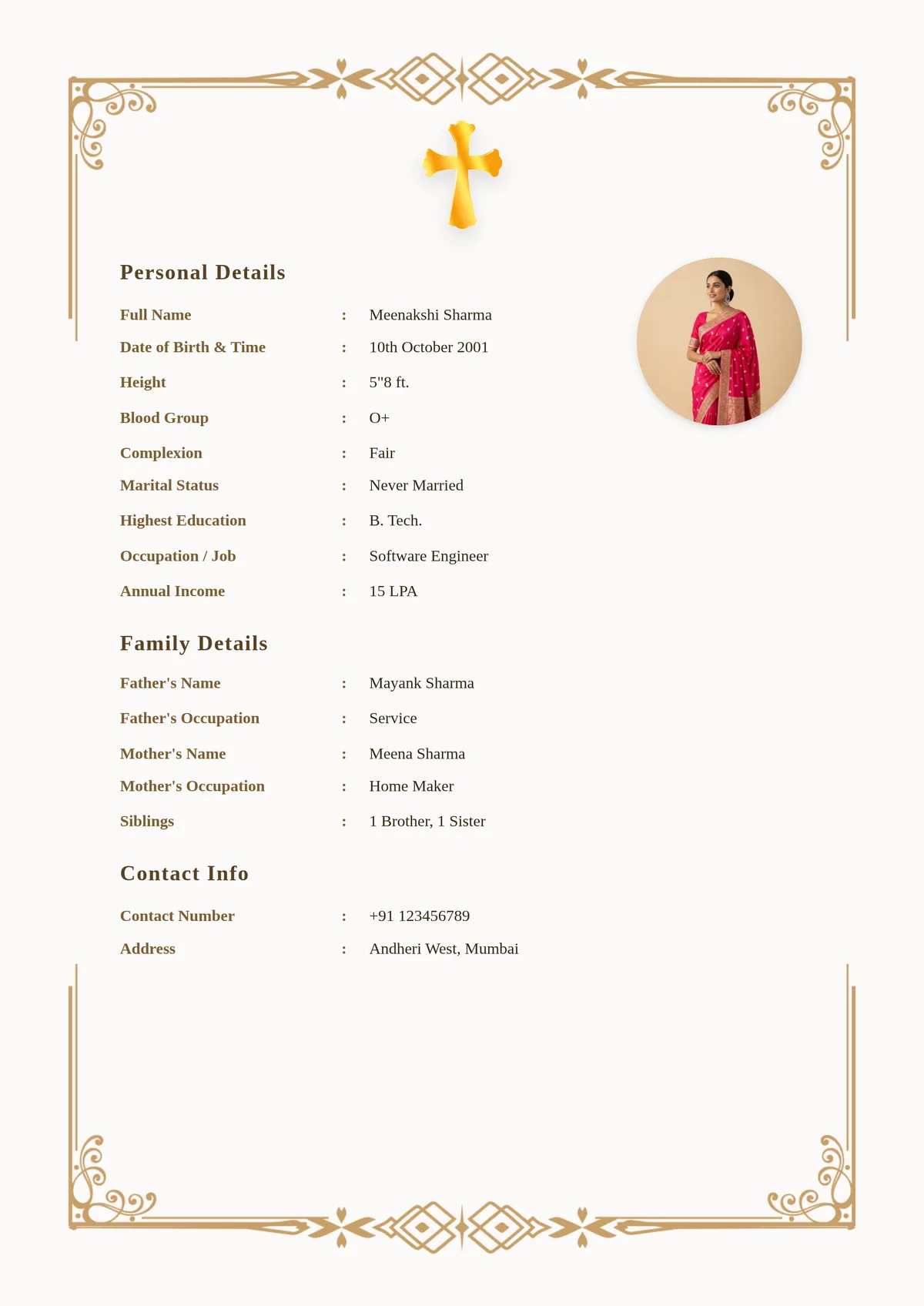
A classic Christian biodata format featuring the "By God's Grace" header and clear religious details—built with BiodataBuilder.
3. Indian Christian Denominations Explained
Unlike preparing a modern secular biodata, a Christian biodata must be hyper-specific about your denomination. Indian Christian communities have deeply rooted, distinct traditions. The denomination you belong to significantly affects who you are likely to match with.
| Denomination | Common In | Biodata Specifics Needed |
|---|---|---|
| Roman Catholic | Goa, Mangalore, Mumbai, TN | Must include Parish name. Often requires stating Sacrament history (Baptism, Confirmation, First Communion). |
| CSI / CNI | South & North India | Church name and Diocese. Generally more liberal regarding cross-denomination marriages. |
| Jacobite / Syrian Orthodox | Kerala | Family church and diocese are critical. High community endogamy (preferring to marry within the community). |
| Pentecostal / AG | Pan-India (urban) | Extremely strict on "born again" and water-baptized status. Fellowship name is required. |
4. Do Christian Biodatas Include Horoscopes?
This is one of the most frequently asked questions, and the answer varies significantly depending on your specific regional community. As a general rule: Most Indian Christian families do not practice horoscope (Kundali) matching.
The Exceptions
- Kerala and Tamil Nadu Communities: Certain Catholic and orthodox families in these regions culturally retain the practice of "star matching" (Nakshatra). They may informally ask for birth date, time, and place to ensure the stars are not conflicting, even if the priest does not officially require it for the wedding.
- Blended Traditions: Families with recent ancestral conversions may still hold onto traditional regional customs, including checking Manglik status.
Recommendation: Do not include a Kundali section in your biodata unless your parents specifically instruct you to. If a family needs it, they will ask you for your birth details over WhatsApp after reviewing your main profile.
Include All the Right Church Details
Our automated builder has dedicated, smartly categorized fields for Christian religious details, ensuring you don't miss anything important.
Start Building Now5. Sample "About Me" & Expectations
When writing your "About Me" section, it is highly encouraged to mention your faith naturally, especially if it plays a large role in your daily life. It helps you attract families with similar values.
Example for a Catholic Candidate
"I am a practicing Catholic working as a senior nurse in Pune. Faith is central to my life, and I am an active member of my parish choir. I come from a close-knit, middle-class family in Mangalore. I am independent but deeply value my roots. I am looking for a God-fearing, supportive partner who values family, humility, and mutual respect. We are open to matches from Catholic and CSI families."
Example for a Pentecostal Candidate
"I am a born-again, water-baptized believer working as a software engineer in Bangalore. I serve in the youth ministry at my local AG church. I enjoy reading theology and traveling. I am seeking a spiritually grounded, born-again partner who shares a passion for ministry and wants to build a Christ-centered home. Must belong to a Bible-believing Pentecostal/Charismatic church."
Note: If you are preparing a second marriage biodata, you should also briefly mention your marital status (Divorced/Widowed) respectfully in this section, alongside your faith.
6. Deep Dive: Writing Partner Expectations
In a Christian context, the "Partner Expectations" section often acts as a theological and cultural filter. While secular profiles might focus purely on salary, height, and location, Christian families frequently use this section to establish spiritual baselines.
Here are the three levels of specificity you can use:
- Strict Endogamy (Same Denomination Only):
"Seeking a God-fearing, professionally stable partner strictly from the Mar Thoma Syrian Church. Must be willing to settle in the Middle East or Kerala." - Broad Compatibility (Open to Similar Traditions):
"Looking for a supportive, family-oriented partner. We are Roman Catholics, but open to matches from CSI and CNI backgrounds provided the partner respects our traditions." - Faith-First (Denomination Agnostic):
"Seeking a born-again, Spirit-filled believer who prioritizes Christ above all. Denomination does not matter as long as the partner has a personal relationship with Jesus."
Being explicit here saves immense amounts of time. If your parents will absolutely not agree to a cross-denominational marriage, state it clearly in the expectations to prevent uncomfortable conversations later down the line.
6. Formatting Do's and Don'ts
What to Do
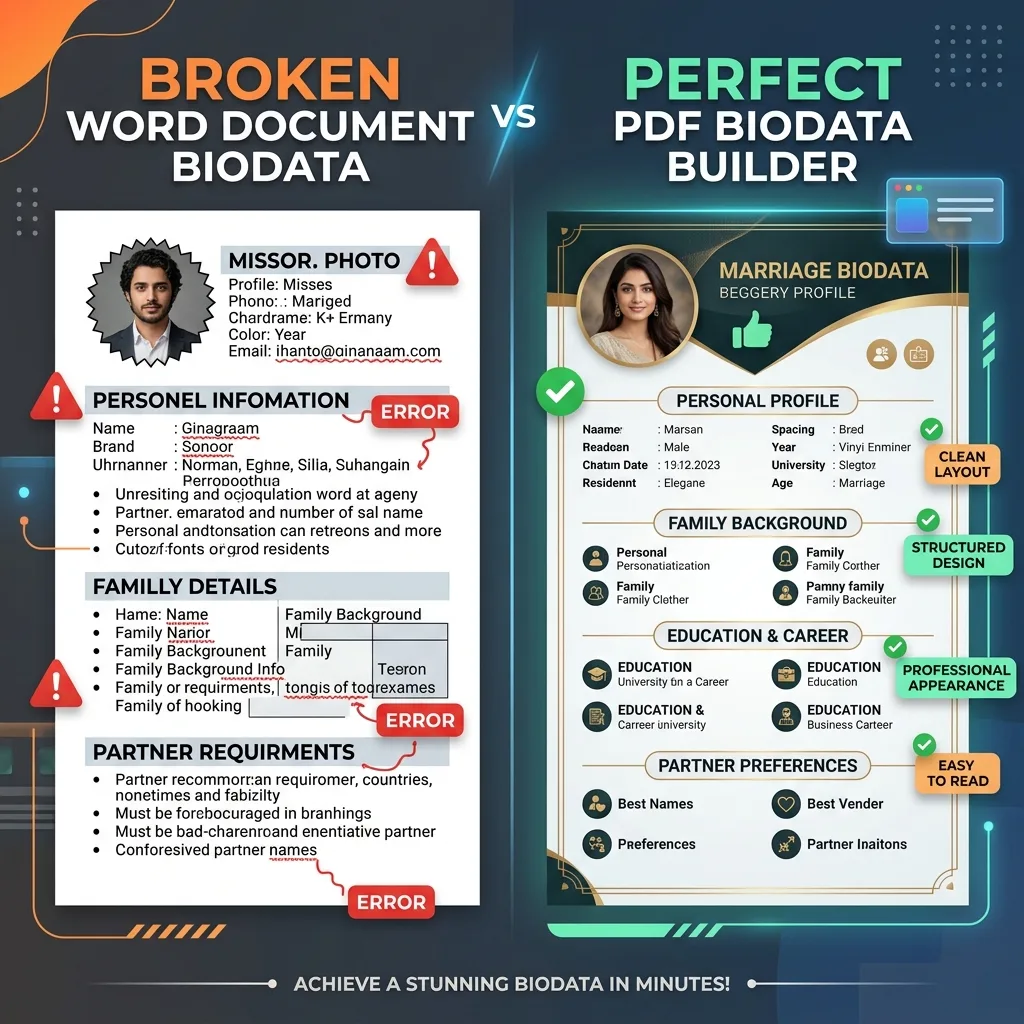
- Do use a clean, modern PDF format rather than an editable Word document.
- Do explicitly mention your Church/Parish name; families use this to verify community ties.
- Do include a polite spiritual heading like "By God's Grace" at the very top.
- Do include your Baptism and Confirmation status if you are Catholic.
What to Avoid
- Don't include Kundali/Gotra sections unless your specific community practices it.
- Don't just write "Christian." Indian Christianity is vast; always specify the denomination.
- Don't use overly informal language. This is a family document, not a dating app profile.
- Don't forget to list siblings' marital status and their spouse's denomination, as families look at existing alliances.
For more general advice on creating a high-conversion profile, check out our 15 expert biodata tips.
7. Bible Verses to Open Your Christian Marriage Biodata
Many Indian Christian families open their biodata with a short scripture verse before the main content. It immediately signals faith, sets a reverent tone, and is expected in conservative communities. Keep it to one verse — brief and joyful works far better than a long passage that takes up precious space.
| Reference | Verse | Best For |
|---|---|---|
| Ruth 1:16 | "Where you go I will go, and where you stay I will stay. Your people will be my people and your God my God." | All denominations — commitment and unity |
| 1 Corinthians 13:4 | "Love is patient, love is kind. It does not envy, it does not boast, it is not proud." | Modern couples, all communities |
| Psalm 37:4 | "Delight yourself in the Lord, and he will give you the desires of your heart." | Faith-first families, Pentecostal / AG |
| Proverbs 18:22 | "He who finds a wife finds what is good and receives favour from the Lord." | Groom's biodata — all denominations |
| Genesis 2:24 | "That is why a man leaves his father and mother and is united to his wife, and they become one flesh." | Traditional Catholic, CSI, Jacobite families |
Place the verse just below the cross icon and heading (“By God's Grace”), before your personal details. Use a slightly smaller font size so it does not dominate the page.
7. Frequently Asked Questions
What should a Christian marriage biodata include?
A Christian marriage biodata should include: personal details (name, DOB, height), religious details (denomination, church name, baptism status), education and career, family background (parents' names and occupations, siblings), About Me, partner expectations, and contact information.
Do Christian families use horoscope matching in a biodata?
Most Protestant and Catholic families do not use Kundali/horoscope matching. However, some Indian Christian communities (particularly in Kerala and Tamil Nadu) still include birth details and consult astrologers for basic star matching. Exclude the astrological section unless it is explicitly your family tradition.
Should I mention my denomination in a Christian biodata?
Yes — always. Indian Christian denominations (Catholic, CSI, CNI, Jacobite, Pentecostal, Mar Thoma, etc.) have distinct traditions. Families often prefer matches within the same denomination or at least within compatible liturgical traditions.
What heading should I use for a Christian marriage biodata?
Common spiritual headings include: 'By God's Grace', 'To God Be the Glory', 'In Jesus Name', or simply 'Marriage Biodata'. Adding a small cross icon at the top of the page is a standard and highly respected design element.
Is a Christian biodata different from a Muslim biodata?
Yes. While the core personal and professional fields remain the same, religious fields differ heavily. For example, a Christian biodata asks for Church Name and Baptism status, whereas a Muslim biodata asks for Sect (Sunni/Shia), Maslak, and religious practices (Salat). See our guide on the Muslim format for comparison.
Conclusion
A beautifully formatted Christian marriage biodata acts as an ambassador for your family. By cleanly organizing your professional achievements alongside your denomination, church details, and spiritual values, you ensure that you attract families who share your traditions and worldview.
Remember to skip the astrological sections unless culturally required by your specific community, and always present the document as a clean, easy-to-read PDF.
Create a Beautiful Christian Biodata Today
BiodataBuilder provides specialized templates for Christian profiles, complete with Cross icons, Denomination fields, and elegant styling. Download your PDF in minutes.
Create Biodata FreeWhat to Read Next
Ready to create your biodata?
Use our free builder to make a WhatsApp-ready marriage biodata PDF in minutes.
Open free biodata maker