Rajan Kumar
Founder, BiodataBuilderRajan built BiodataBuilder to help millions of Indians create professional marriage biodatas easily. With expertise in Indian matrimonial traditions and 2M+ biodatas created on the platform, his guides cover every regional format, community custom, and modern best practice.
Last Updated:
Biodata vs Resume vs CV — The Real Difference Explained
TL;DR - The Quick Summary
- Biodata: Used exclusively for arranged marriage matchmaking. Includes personal details like religion, caste, family background, and horoscope.
- Resume: Used for corporate job applications. 1-2 pages focusing strictly on relevant work experience, education, and skills. Never includes personal details like religion.
- CV (Curriculum Vitae): Used for academic, medical, and research roles. A comprehensive, multi-page document detailing your entire professional and academic history.
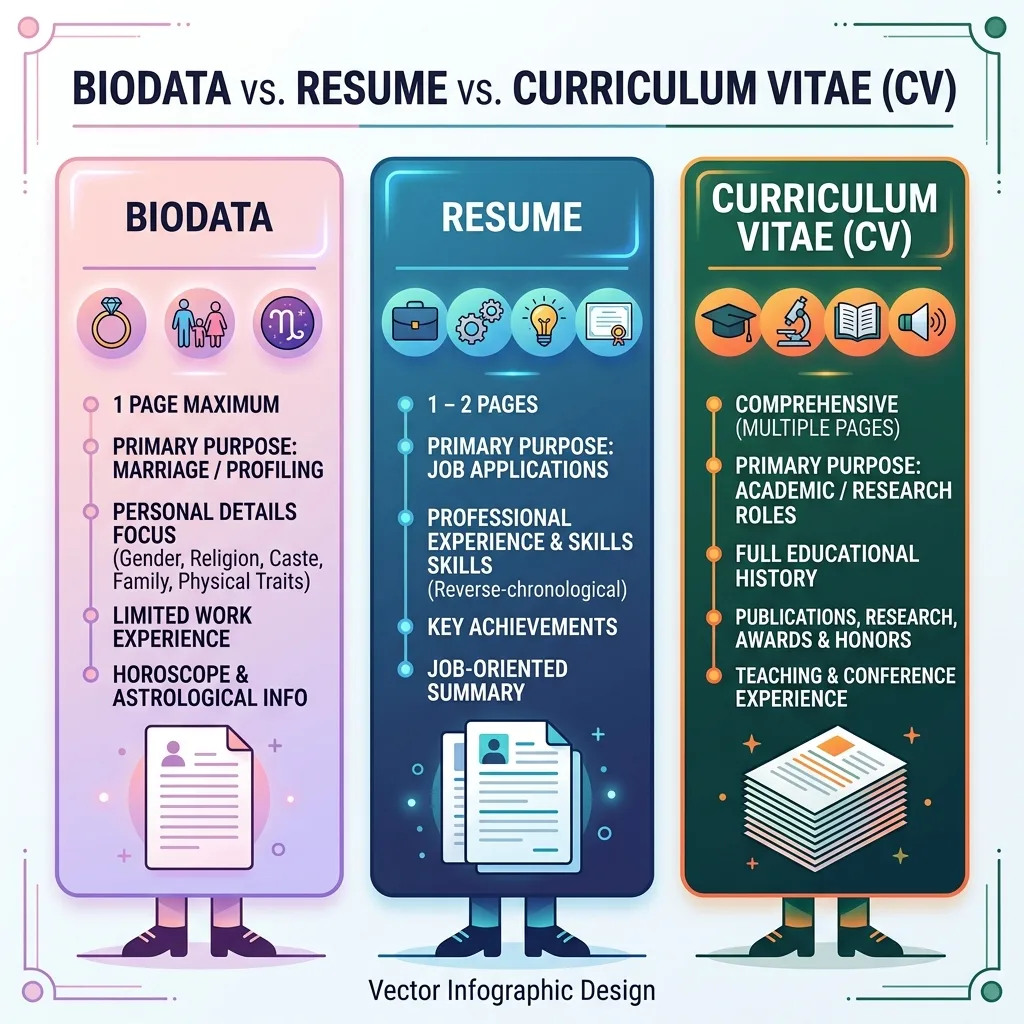
In many parts of the world, especially in India and South Asia, the terms Biodata, Resume, and CV are often used interchangeably. People frequently ask for a "biodata" when they actually mean a resume, or they submit a CV when a 1-page resume is expected.
However, submitting the wrong document in the wrong context can create a very poor impression. Submitting a highly personal marriage biodata to an employer could cost you the job, while sending a sterile corporate resume to a prospective matchmaking family will likely get you rejected for lacking personal detail.
They are three completely different documents designed for three completely different purposes. In this comprehensive guide, we will break down the exact differences, provide a clear comparison, and give you the confidence to know exactly which document to use and when. Whether you are applying for a highly competitive job or embarking on the arranged marriage journey, you'll have the exact right document in hand.
2. Quick Comparison Table
| Feature | Biodata (Marriage) | Resume (Jobs) | CV (Academic) |
|---|---|---|---|
| Primary Purpose | Arranged marriage matchmaking | Corporate job applications | Academic, research, or medical roles |
| Standard Length | Strictly 1 page | 1–2 pages | 2–10+ pages (No strict limit) |
| Personal Details (Religion, Caste, etc.) | ✅ Mandatory | ❌ Never Included | ❌ Never Included |
| Horoscope & Astrological Data | ✅ Highly Expected | ❌ Never Included | ❌ Never Included |
| Family Background Details | ✅ Mandatory | ❌ Never Included | ❌ Never Included |
| Educational History | Brief summary | Highest degrees relevant to job | Comprehensive history of all degrees |
| Work Experience | Current job, salary, company | Detailed reverse-chronological history | Comprehensive history, including teaching |
| Customization per Use | Fixed format (rarely changed) | Highly customized per job application | Rarely tailored, constantly updated |
| Photo Inclusion | ✅ Yes (Crucial) | ❌ Usually No (in US/UK/India corporate) | ❌ Usually No (varies by country) |
3. What is a Biodata? (Marriage vs Job)
The word "biodata" is short for biographical data. In the context of South Asian culture (specifically India, Pakistan, Bangladesh, and Nepal), a biodata is almost exclusively associated with arranged marriages. However, older generations or smaller businesses may still incorrectly use the term when asking for a resume. Let's look at the difference.
A. The Marriage Biodata
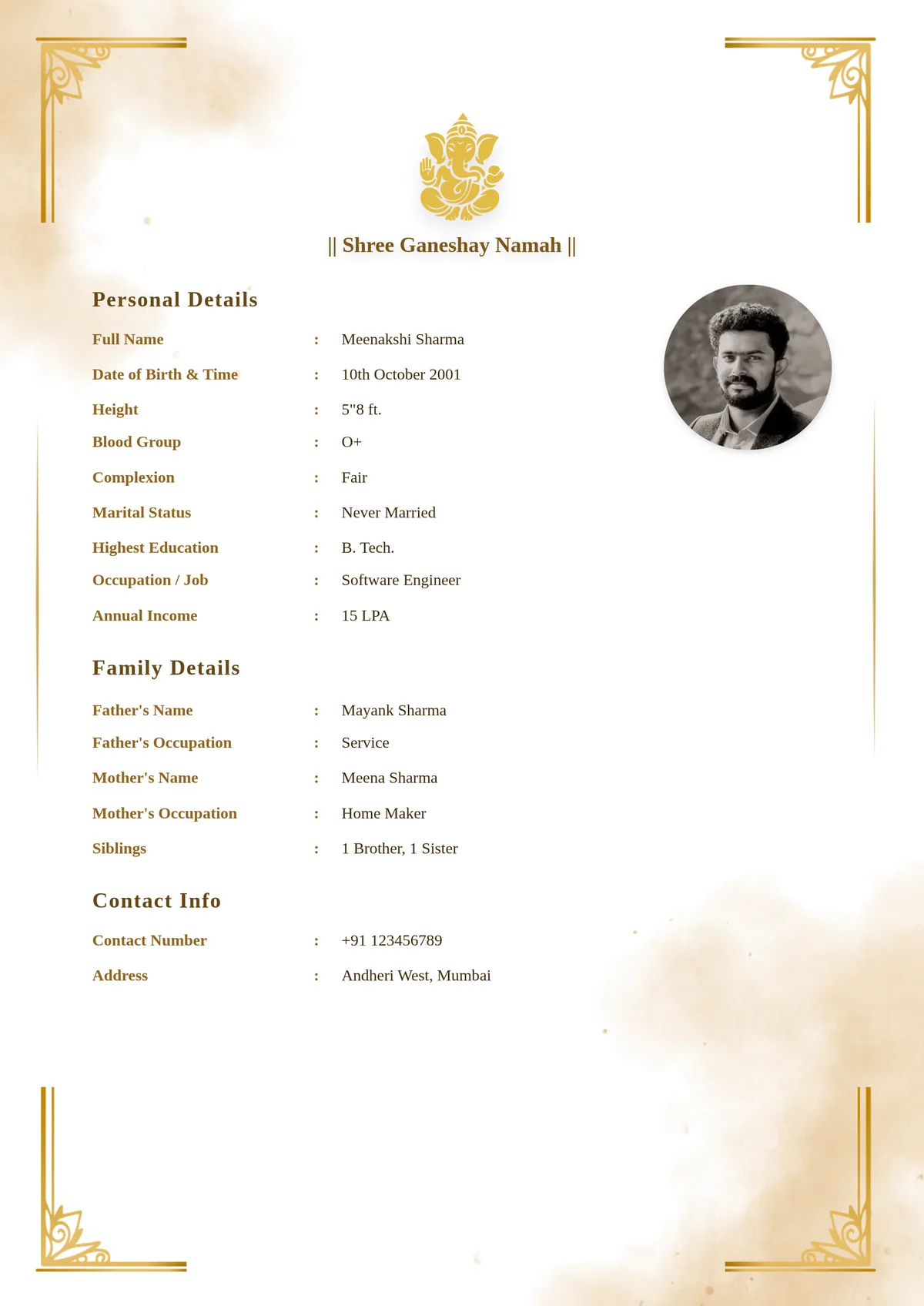
A marriage biodata is a structured, 1-page profile that serves as the "first impression" in the arranged marriage matchmaking process. Before two families agree to meet, they exchange biodatas to ensure basic compatibility regarding religion, social status, and astrology. If you want to learn more, check out our guide on how to write a biodata about me.
What a standard marriage biodata contains:
- Personal Details: Full name, date of birth, precise time of birth, place of birth, height, blood group, complexion, and any disabilities.
- Religious & Community Background: Religion, caste, sub-caste, gotra (lineage), and native place.
- Astrological Profile: Rashi (Moon sign), Nakshatra (Birth star), Manglik status, and Kundali matching details.
- Education & Career: Highest degree earned, current job title, company name, and annual income.
- Family Details: Father's name and occupation, Mother's name and occupation, number of brothers and sisters (and their marital status), and family type (nuclear vs. joint).
- Partner Preferences: A brief note on the type of partner expected (e.g., "Looking for a well-educated, vegetarian girl from a respectable family").
B. The "Job Biodata" (Outdated Term)
Decades ago, before the terms "resume" and "CV" became standardized in India, applying for government jobs or clerical positions required a "biodata." This was basically a simple form that included date of birth, gender, marital status, and a list of degrees. Some regional areas still ask for a biodata format in Hindi for basic jobs, but this is increasingly rare.
Important: If a modern corporate employer asks you for your "biodata," they actually mean your Resume. Do not send them a document detailing your caste, religion, or parents' occupations. This is highly unprofessional. Send a standard 1-2 page resume instead.
Looking to Create a Marriage Biodata?
Don't use a boring Word document. Use our specialized builder to create a beautiful, traditionally formatted marriage biodata in minutes. Download as PDF instantly.
Create My Marriage Biodata4. What is a Resume?
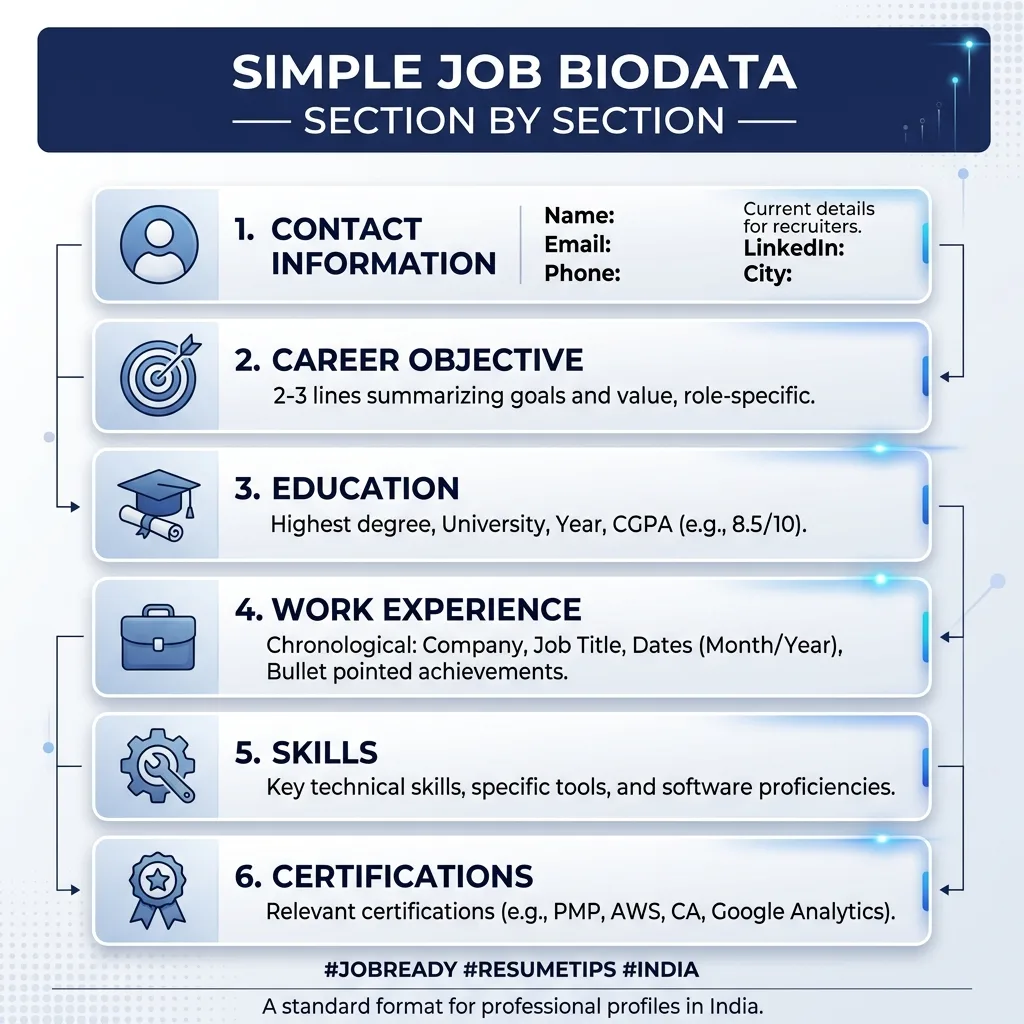
A Resume is a concise document, typically 1 to 2 pages long, used specifically for job applications. The word comes from the French word "résumé," meaning "summary." It is meant to be a quick, scannable overview of your skills, education, and work experience relevant to the specific job you are applying for. When building one, it's helpful to review general formatting tips to stand out.
Unlike a CV, a resume is not a comprehensive history. It should be tailored for every single job application. If you are applying for a graphic design role, you emphasize your design experience and remove the cashier job you had 5 years ago.
What a modern resume contains:
- Contact Information: Name, professional email address, phone number, LinkedIn URL, and portfolio link (if applicable).
- Professional Summary: A 3-4 sentence elevator pitch at the top explaining who you are and the value you bring.
- Work Experience: Your recent jobs listed in reverse-chronological order (newest first). This should focus on measurable achievements (e.g., "Increased sales by 20%"), not just day-to-day duties.
- Education: Your relevant degrees and universities. You do not need to list your high school marks if you have a bachelor's degree.
- Skills: A list of hard skills (e.g., Python, Photoshop, SEO) and soft skills (e.g., Leadership, Communication).
5. What is a CV (Curriculum Vitae)?
Curriculum Vitae (CV) is Latin for "course of life." As the name suggests, it is a highly detailed, comprehensive document detailing your entire academic and professional career. You can read more about its history on Wikipedia.
A CV does not have a page limit. While a junior researcher might have a 2-page CV, a senior university professor might have a 20+ page CV detailing every paper they have ever published. CVs are primarily used in academia, science, research, and medicine. It is completely different from a traditional biodata.
What a standard CV contains (in addition to resume details):
- Comprehensive Educational History (including dissertation/thesis titles)
- Teaching Experience and Guest Lectures
- Research Experience and Lab Work
- Peer-Reviewed Publications and Books
- Conference Presentations and Posters
- Grants, Fellowships, and Scholarships
- Professional Affiliations and Licenses
Note: In some parts of Europe and the Middle East, the term "CV" is used interchangeably with "resume." However, in the US, Canada, and India, the distinction between a short corporate resume and a long academic CV is strictly maintained.
Tired of Formatting Your Marriage Biodata Manually?
Skip the MS Word templates. Choose from our premium, culturally-appropriate designs and get a beautiful PDF in under 5 minutes.
Start Building Now6. Format Examples & Differences
To make it crystal clear, let's look at how the exact same person would introduce themselves differently on a Biodata versus a Resume. This is especially true for specific religious formats, like the best marriage biodata format for a Hindu.
On a Marriage Biodata
- Name: Priya Sharma
- DOB: 14 August 1996, 04:30 PM
- Height: 5'4"
- Religion/Caste: Hindu, Brahmin
- Gotra: Kashyap
- Education: B.Tech in Computer Science
- Profession: Software Engineer at TCS
- Income: 12 LPA
- Father: Mr. Rajesh Sharma (Bank Manager)
On a Job Resume
- Name: Priya Sharma
- Contact: priya.sharma@email.com | +91 98765 XXXXX
- Summary: Detail-oriented Software Engineer with 4 years of experience building scalable React applications...
- Experience: Software Engineer, TCS (2018 - Present)
- - Architected a micro frontend resulting in 30% faster load times.
- Education: B.Tech, XYZ University (2014-2018)
- Skills: React, Node.js, TypeScript, AWS
7. The 10-Point Self-Check Checklist
Before you send your document, ask yourself these 10 questions to ensure you are using the right format for the right audience:
- Are you applying for a corporate job? Use a Resume.
- Are you sending details to a potential matrimonial match? Use a Biodata.
- Are you applying for a PhD program? Use a CV.
- Does it include your religion or caste? Must be a Biodata.
- Does it list every paper you've ever published? Must be a CV.
- Is it exactly 1 page and focuses on hard skills? Must be a Resume.
- Does it include your height and blood group? Must be a Biodata.
- Does it list your parents' names and jobs? Must be a Biodata.
- Is it tailored specifically to a job description? Must be a Resume.
- Does it include your time and place of birth? Must be a Biodata.
8. Frequently Asked Questions
What is the difference between a biodata and a resume?
A biodata is for marriage matchmaking and includes deeply personal details like religion, caste, horoscope, and family background. A resume is for corporate jobs and focuses strictly on your education, work experience, and skills.
What is a biodata used for?
In South Asia, a biodata is almost exclusively used for arranged marriage matchmaking. It gives prospective families a comprehensive overview of the person's background before deciding to meet.
What is the difference between a CV and a resume?
A resume is a short (1-2 pages) summary tailored to a specific job. A CV is a comprehensive, multi-page record of your entire academic and professional history, typically used for research or medical roles.
Should I use a biodata or resume for a job?
Always use a resume for job applications. Submitting a marriage biodata with personal sensitive information (religion, family details) is inappropriate in corporate hiring contexts.
Can I use a resume format for marriage?
No. A resume lacks the crucial personal, family, and astrological details that families require for arranged marriage matchmaking. You must use a dedicated marriage biodata format.
9. Conclusion
Understanding the difference between a Biodata, a Resume, and a CV is crucial to ensuring you present yourself correctly in any situation.
To summarize: If you are looking to get married, you need a Biodata. If you are applying for a standard corporate job, you need a Resume. If you are applying for a PhD or a professorship, you need a CV.
By using the correct document, you show that you understand the cultural or professional expectations of the person receiving it, putting your best foot forward right from the start.
Create Your Perfect Marriage Biodata Today
Join thousands of users who have successfully created their marriage profiles using our specialized tool. It's fast, free, and perfectly formatted.
Create Biodata NowWhat to Read Next
Ready to create your biodata?
Use our free builder to make a WhatsApp-ready marriage biodata PDF in minutes.
Open free biodata maker