Rajan Kumar
Founder, BiodataBuilderRajan built BiodataBuilder to help millions of Indians create professional marriage biodatas easily. With expertise in Indian matrimonial traditions and 2M+ biodatas created on the platform, his guides cover every regional format, community custom, and modern best practice.
Last Updated:
Muslim Marriage Biodata Format: The Complete Rishta Guide
TL;DR - The Quick Summary
- What is a Rishta Biodata? The Islamic equivalent of a marriage profile, used widely across South Asia and the diaspora for arranged marriages.
- Key Differences: Unlike standard Hindu biodatas, a Muslim biodata often omits astrology (Kundali) but heavily emphasizes Sect (Sunni/Shia), Madhab, and Practicing Level.
- Crucial Elements: Always include the Wali (guardian) contact details and clearly state your community/Biraderi if your family prefers matching within the same clan.
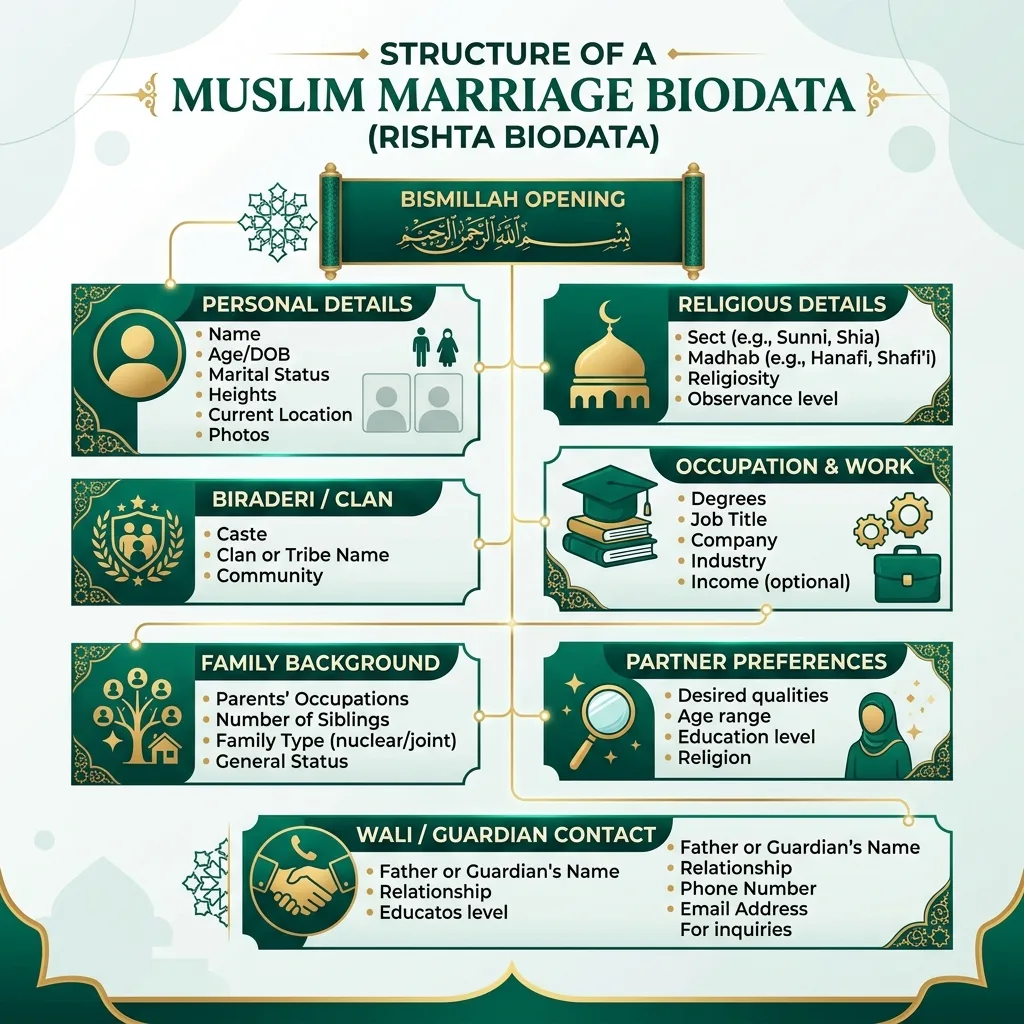
In Islamic culture, particularly across India, Pakistan, Bangladesh, and their global diasporas, the arranged marriage process begins with the exchange of a Rishta Biodata. Finding a compatible spouse is considered half of one's Deen (faith), and the biodata serves as the vital first introduction between two families.
A Muslim marriage biodata differs significantly from other religious formats. While you won't include details like Gotra or Kundali, you must clearly outline your Islamic identity—including your Sect, Madhab, and everyday practicing habits (like praying five times a day or observing Hijab). This transparency ensures that both families are aligned in their religious and lifestyle expectations right from the start.
Whether you are creating a biodata for a boy or a girl, this comprehensive guide will walk you through exactly what to include in a Muslim biodata, how to phrase delicate subjects, and how to present yourself respectfully and authentically.
2. The Complete Muslim Biodata Field Guide
| Section | Fields to Include | Guidance & Context |
|---|---|---|
| Islamic Opening | Bismillah / Assalamu Alaikum | Standard on all Muslim biodatas. Often placed at the very top center to begin the document with God's name. |
| Personal Details | Name, DOB, height, blood group, marital status | Include both your Islamic name and common name if applicable. Be honest about height. |
| Religious Details | Sect (Sunni/Shia), Madhab, Practicing level, Hijab/Beard status | Crucial for compatibility. Always include this to avoid mismatched expectations. |
| Biraderi / Clan | Community name (e.g., Syed, Pathan, Memon) | Include if community matchmaking is expected by your elders. |
| Education & Career | Highest degree, institution, job title, income | State your profession and income clearly, as a man's financial stability relates to his Islamic obligations to provide. |
| Family Background | Father & mother (name + occupation), siblings | Detail your siblings' marital status and family type (nuclear vs. joint). |
| About Me | Values, personality, lifestyle, religious habits | A paragraph humanizing you. See our guide on writing about me for tips. |
| Expectations | Partner preferences — 2–3 sentences | Mention preferred Sect, practicing level, education, and family values. |
| Wali Contact | Father/guardian name and WhatsApp number | Essential in Islamic tradition. Signals proper family involvement and respect. |
3. Stating Your Sect & Practicing Level
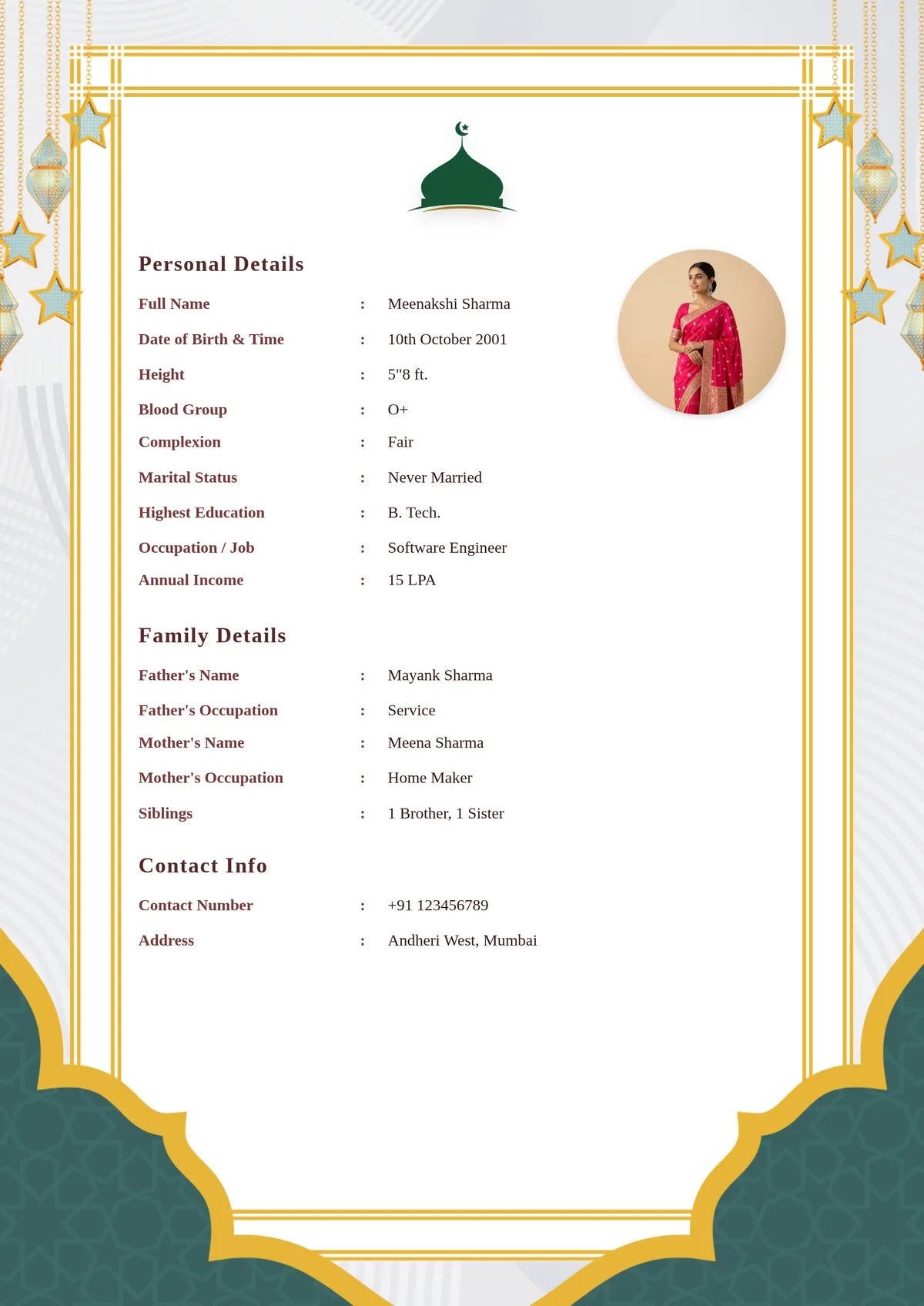
In Islamic matchmaking, theological compatibility is just as important as personality. Be clear and factual—stating your Sect is not a statement of superiority, but a practical filter that saves both families time.
If your family is open to inter-sect marriages, you can simply write "Sunni (Open to all)" or "Muslim - Just Muslim." However, if they strictly want a specific sect or school of thought, state it clearly:
Religion: Islam
Sect: Sunni (Hanafi)
Practicing Level: Practicing — Pray 5 times a day, observe Ramadan fasts, eat Zabiha Halal only.
Note: Detailing your practicing level is increasingly expected in modern biodatas, especially for Muslims in Western countries (US, UK, Canada). It helps clarify lifestyle expectations regarding Hijab/Beard, diet, and daily prayers. If you are exploring broader formats, see our biodata tips for modern families.
4. Should You Include Biraderi?
Biraderi refers to the clan, community, or caste identity common in South Asian Muslim cultures (e.g., Syed, Sheikh, Pathan, Ansari, Memon, Bohra, Rajput Muslims). While many younger Muslims prefer not to include this, older generations heavily rely on it for matchmaking.
If your parents are arranging the marriage and they strongly prefer matching within your own community, you must include your Biraderi. Omitting it will lead to irrelevant matches and frustration. If caste is not a barrier for you, you can state: "Caste no bar (Sunni Muslim preferred)." For insights into how other communities handle this, compare it with the Tamil Thirumanam biodata format where caste is also a primary filter.
Create Your Rishta Biodata Free
Add a Bismillah opening, your Sect, and Biraderi perfectly. Download a beautiful, culturally-appropriate PDF in minutes. No sign-up required.
Create Muslim Biodata5. Writing the Perfect "About Me"
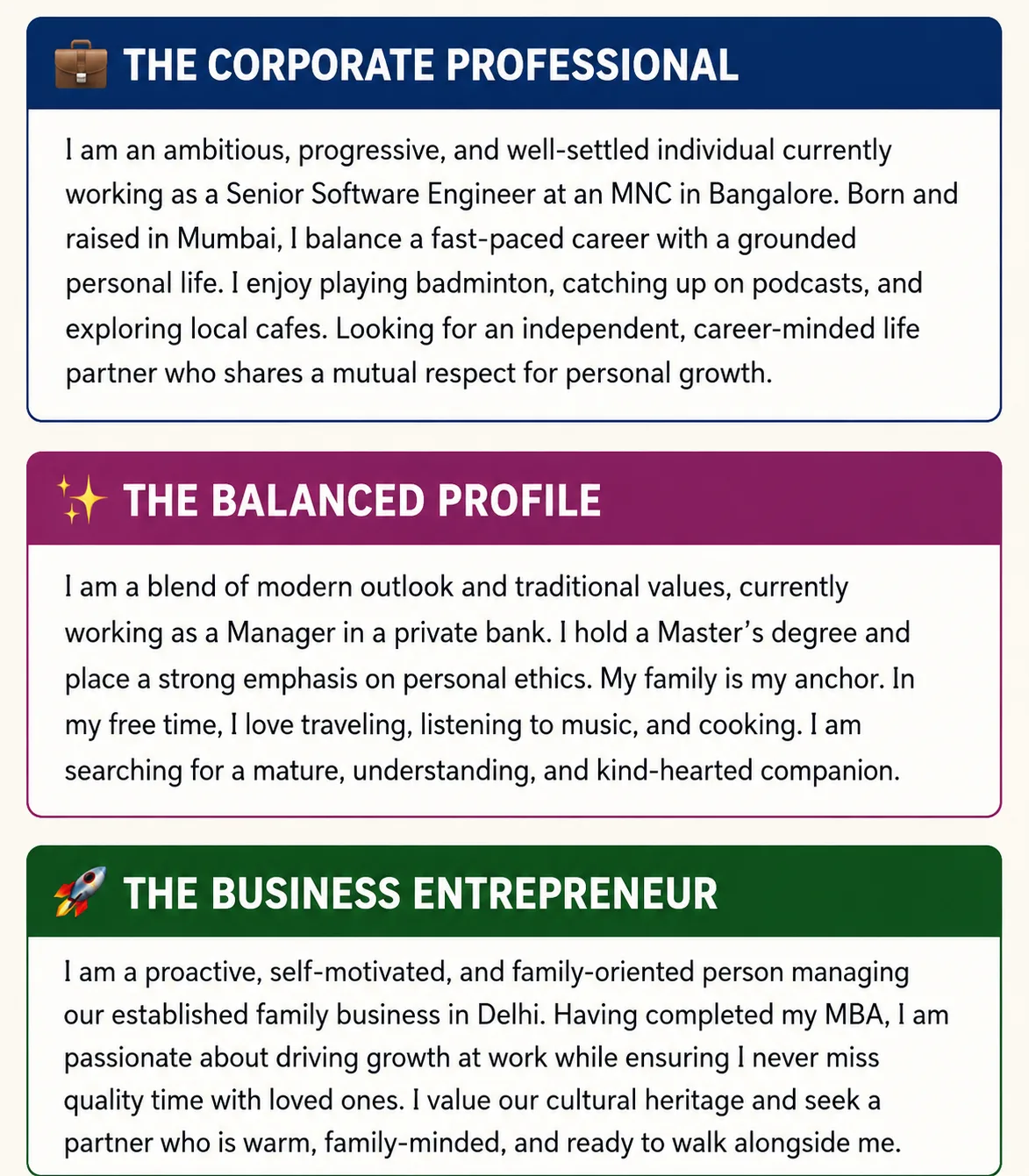
The "About Me" section is where your biodata comes alive. Rather than just listing facts, use 3 to 4 sentences to describe your personality, your relationship with your faith, and your outlook on life.
Sample "About Me" for a Muslim Boy:
When creating a biodata for a girl, the tone can be similarly balanced, emphasizing education, career ambitions (if any), and family values. Avoid using cliché phrases; speak genuinely so the receiving family can sense your true personality.
6. The Wali (Guardian) Contact Section
In Islamic marriage traditions, a Wali is a male guardian (typically the father, elder brother, or paternal uncle) who is responsible for the bride during the Nikah process.
Even if you are an independent working professional, including a Wali's contact information in your biodata signals respectful family involvement and adherence to Islamic protocol. It is highly reassuring to prospective families. If your family operates differently, you might find broader regional approaches interesting, such as the Marathi biodata format which also heavily emphasizes family elders.
Example Wali Contact:
Contact (Wali): Mohammad Ibrahim — Father
WhatsApp: +91-98XXX-XXXXX
Email: ibrahim.family@email.com
7. Mentioning Mehr Expectations
Mehr (or Mahr) is the mandatory gift given by the groom to the bride at the time of marriage. A common question is: "Should I write the Mehr amount on the biodata?"
In most cases, the answer is No. Mentioning a specific financial amount on the initial biodata can seem overly transactional and is generally discouraged. The biodata is just an introduction; financial negotiations should happen in person between the families later.
Tired of Using MS Word for Biodatas?
Our builder automatically formats your Rishta Biodata into a beautiful, respectful PDF. Choose from premium templates explicitly designed for Muslims.
Start Building Now8. Muslim Biodata Checklist
Before you finalize and send your biodata to a prospective family, review this 10-point checklist to ensure it meets community expectations. Remember, a marriage biodata is entirely different from a professional resume.
- Is the Bismillah or an Islamic opening included at the top?
- Have you clearly stated your Sect (e.g., Sunni, Shia) and Madhab?
- Is your practicing level (prayers, fasting, Hijab) accurately described?
- Did you include your Biraderi/Clan (if relevant to your family)?
- Are your height, age, and marital status 100% accurate?
- Are your education and current job/income listed clearly?
- Are the names and occupations of both parents listed?
- Did you mention the number of siblings and their marital status?
- Is there a respectful 'About Me' paragraph explaining your values?
- Is the Wali (guardian) listed as the primary contact with a phone number?
Important: Do not use this format for job applications. If you need a document for a job in India or the Middle East, use a standard Job Biodata format instead.
9. Frequently Asked Questions
What should a Muslim marriage biodata include?
An Islamic opening (Bismillah), personal details, religious details (Sect, Madhab, practicing level), Biraderi/clan, education, career, family background, 'About Me', and Wali contact details.
What is Biraderi in a Muslim biodata?
Biraderi refers to clan/caste identity in South Asian Muslim communities (e.g., Syed, Sheikh, Pathan, Ansari, Memon, Bohra). Many families, particularly in Pakistan-origin or UP/Bihar communities, still match within the same Biraderi.
Should I mention Sect (Sunni/Shia) in a Muslim biodata?
Yes — always. Specifying your Sect (Sunni, Shia, Ahmadiyya, Ismaili, Bohra, etc.) upfront avoids mismatched expectations. State it as a neutral fact, not as a filter.
What should the Wali contact section say?
It should include the father's (or brother's/uncle's) name, relationship, and WhatsApp number. Example: 'Contact: Mohammad Ibrahim (Father) — +91-XXXXX-XXXXX'. This signals family involvement.
Do I need to mention Mehr in a Muslim biodata?
No, mentioning Mehr in the initial biodata is entirely optional. Some families include a brief expectation to set a baseline, but most prefer to discuss Mehr during family meetings.
Conclusion
Creating a Muslim marriage biodata requires a delicate balance of providing necessary personal details while clearly conveying your religious identity and lifestyle. Unlike a generic Word document template, a dedicated Rishta biodata ensures that crucial elements like your Sect, practicing level, and Wali contact are front and center.
By following this guide, you can create an honest, respectful, and highly effective biodata that helps your family find a truly compatible match.
Create Your Muslim Rishta Biodata — Free
Add a Bismillah opening, Sect, Biraderi, Wali contact, and all essential details easily. Generate a beautiful PDF in minutes. No sign-up required.
Create Muslim Biodata FreeWhat to Read Next
Ready to create your biodata?
Use our free builder to make a WhatsApp-ready marriage biodata PDF in minutes.
Open free biodata maker