Rajan Kumar
Founder, BiodataBuilderRajan built BiodataBuilder to help millions of Indians create professional marriage biodatas easily. With expertise in Indian matrimonial traditions and 2M+ biodatas created on the platform, his guides cover every regional format, community custom, and modern best practice.
Last Updated:
Biodata for Second Marriage: A Dignified, Honest Guide
TL;DR — Key Takeaways
- Always state your marital status clearly — Divorced or Widowed
- Mention children (age + who they live with) — never hide this
- Add "how long ago" — e.g. "Divorced 2 years ago" is more reassuring than just "Divorced"
- Do not explain the reason for divorce — save that for genuine conversations
- Write an About Me that focuses on who you are today, not what you've been through
- Use our free biodata builder to create a clean, dignified PDF in minutes
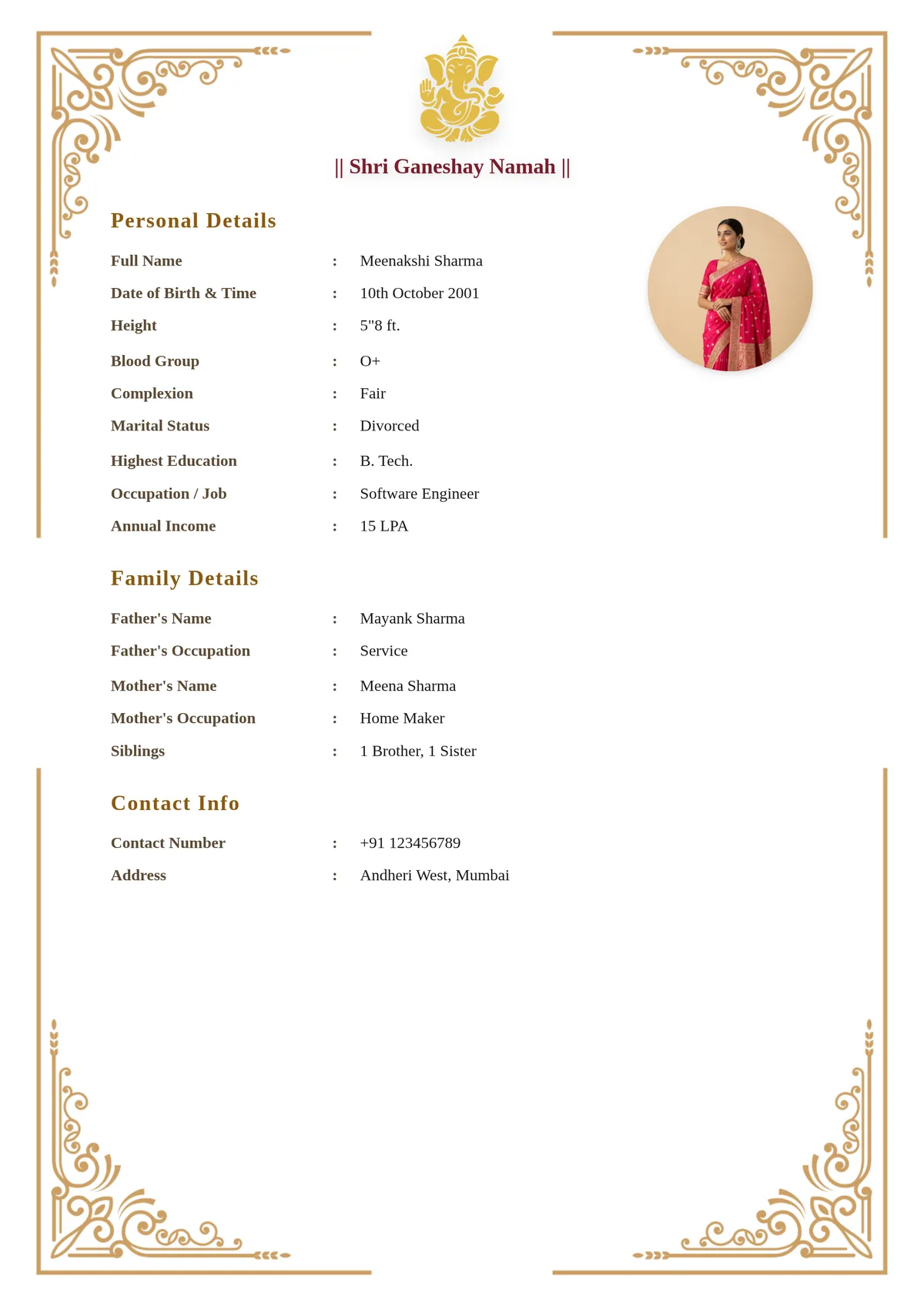
A dignified second marriage biodata — honest, clean, and compassionate
Seeking a second marriage requires a biodata that is honest, dignified, and sensitive. Whether you are divorced or widowed, your biodata sets the tone for mature, respectful conversations. The goal is not to over-explain your past — it is to clearly present who you are today and what you are genuinely looking for.
This guide covers every element: what to include, what to skip, 4 ready-to-use sample texts, cultural considerations, and the most common mistakes people make when writing a second marriage biodata. Whether you're creating a biodata for a divorced man or a biodata for a widowed woman, the principles are the same.
Ready to build your biodata? Our templates are clean, honest, and inclusive. No sign-up needed.
Build My Biodata — Free →Should You Mention a Previous Marriage Upfront?
Yes — always. This is the single most important piece of advice in this guide. Trying to conceal a previous marriage almost always backfires — families exchange Kundali details, ask for references, or simply find out through mutual contacts. When it surfaces later, it destroys trust completely.
Transparency does the opposite: it filters in compatible families from day one. Families who are genuinely open to second marriages will not be deterred by honesty. Those who are not would not have been a good match anyway. By being upfront, you start every conversation on a foundation of respect and clarity.
What to Include & What to Skip
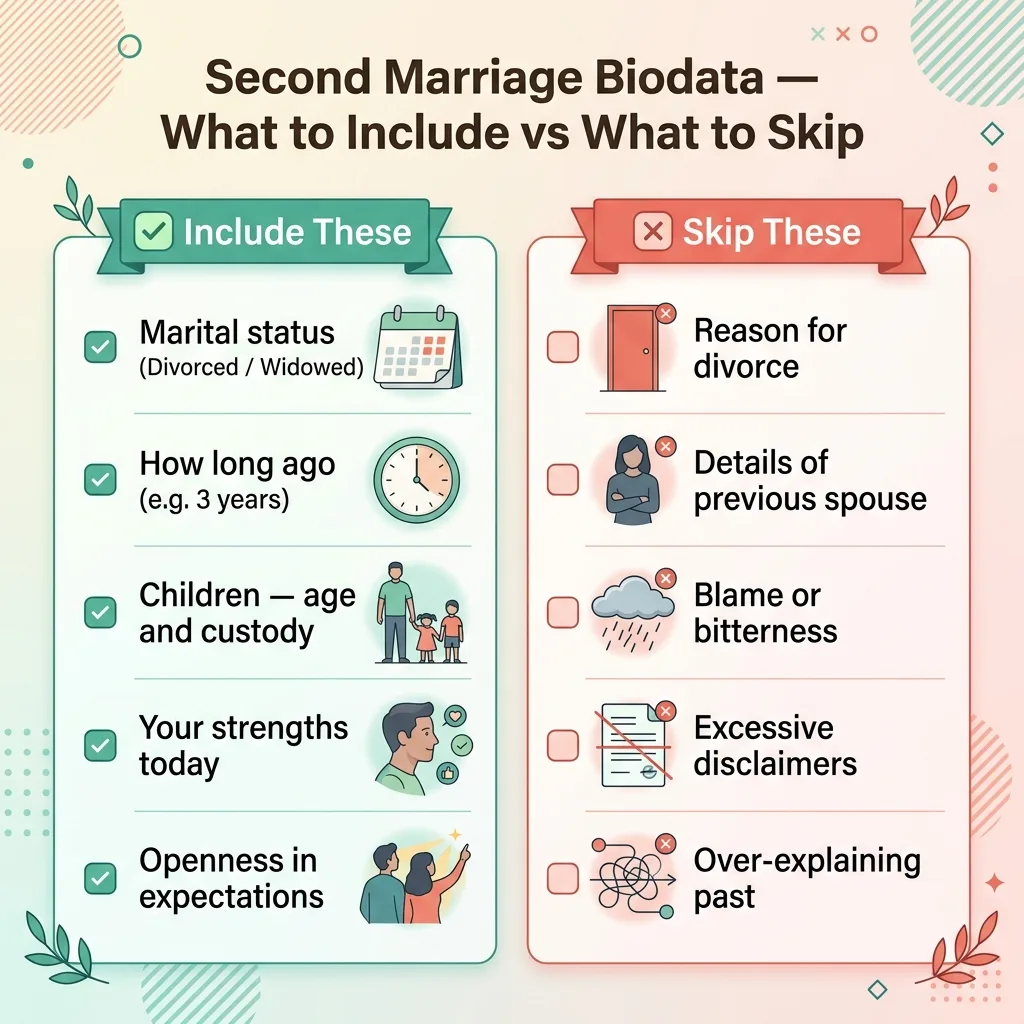
| Field | ✅ Include | ❌ Skip |
|---|---|---|
| Marital Status | "Divorced" or "Widowed" — clearly stated | Vague or absent |
| Duration | "Divorced 2 years ago" / "Widowed 3 years ago" | Just "Divorced" with no context |
| Children | Age + primary custody (e.g. "Son, 7, lives with me") | Hiding children |
| Reason for Divorce | — | Never in a biodata |
| Details of Ex-Spouse | — | Never |
| About Me | Who you are today, your strengths, what you want | Excessive apologies or disclaimers |
| Expectations | Open, warm, 2–3 genuine requirements | Long rigid list of conditions |
| Astrological Details | Rashi, Nakshatra, Gotra (for Hindu families) | Leaving blank for Hindu families |
4 Sample "About Me" Texts for Second Marriage Biodata
The About Me section is the heart of a second marriage biodata. It should focus on who you are today — your strengths, your readiness, your life. For detailed writing guidance, see our About Me writing guide. Here are 4 ready-to-adapt samples:
1. Divorced Woman with Child
2. Widower with Child
3. Divorced Man without Child
4. Widowed Woman without Child
Note: These are illustrative samples. Replace all personal details with your own accurate information.
Build Your Second Marriage Biodata — Free
Use the sample texts above as inspiration. Fill in your details, choose a dignified template, and download your PDF in 2 minutes.
Create My Biodata →Age-Specific Biodata Advice
The tone of a second marriage biodata changes drastically depending on your life stage. What matters most to a 32-year-old seeking to blend a young family is very different from a 55-year-old empty nester seeking deep companionship.
Remarrying in Your 30s
In your 30s, the focus is often on rebuilding, career stability, and potentially starting or blending young families. Expectations around shared responsibilities, financial goals, and child-rearing are paramount.
Remarrying in Your 40s
By your 40s, you likely have an established career and teenage or pre-teen children. The focus shifts towards mature companionship, shared values, and mutual respect for each other's existing routines and obligations.
Remarrying in Your 50s and Beyond
In your 50s and beyond, the focus shifts heavily to deep companionship, health, spirituality, and enjoying an empty nest. Children are usually adults. The tone should be highly independent yet warm.
Writing the Expectations Section: Keep It Compassionate
The expectations section in a second marriage biodata should be open and warm, not a rigid checklist. Avoid placing hard restrictions that make you seem inflexible. The best approach acknowledges mutual openness:
❌ Too Rigid
"Must be from same city, earning 20+ LPA, no previous marriage, below 30 years old, same community."
✅ Warm & Open
"Open to both first and second marriages. Partner should be emotionally mature, family-oriented, and accepting of my child. Location is flexible."
Addressing Finances & Independence
In second marriages, financial clarity is often highly valued. You do not need to list exact salaries or assets, but indicating financial independence or expectations can filter out incompatible matches early.
- Example 1 (Seeking Independence): "Looking for a professionally stable and financially independent partner who values equal partnership."
- Example 2 (Offering Stability): "I am well-settled and financially secure. Seeking a partner who values a peaceful home life; career is entirely optional."
Navigating Blended Families
If either you or your potential partner has children, the expectations section is where you address this openness. This shows you are realistic about what a second marriage entails.
- Example 1 (Open to Step-parenting): "Open to partners with children. I am ready to embrace and support a blended family with warmth and patience."
- Example 2 (Shared Custody): "My son lives with me full-time. I am looking for someone who understands the dynamics of shared parenting and is comfortable building a bond at their own pace."
If you are open to a partner who has also been married before, explicitly say so: "Open to divorcee or widower." This often results in significantly more compatible inquiries and shows emotional maturity.
Navigating Stigma & Answering Tough Questions
Writing a transparent biodata is only the first step. For many seeking a second marriage in India, the anxiety often lies in the conversations that follow. It is important to remember that the social landscape regarding remarriage has shifted significantly; many modern families view divorce as a sign of prioritizing peace over a toxic environment, rather than a taboo.
When a family calls after reviewing your biodata, the inevitable question will arise: "What happened in your first marriage?" Here is how to handle it with dignity and grace:
1. Keep it Brief and Neutral
Avoid badmouthing your ex-spouse or diving into traumatic details during early conversations. This can overwhelm the listener and shift the focus to the past rather than your future.
"We had fundamental differences in our values and realized we were incompatible. We decided to part ways amicably to seek better futures. I’ve learned a lot and am now looking forward to a fresh start."
2. Establish Boundaries Gracefully
If the other party pushes for uncomfortable details too early, it is entirely acceptable to set a polite boundary.
"I hope you understand that it was a difficult chapter, and while I have moved on, I prefer to discuss the deeper details only when we feel there is a genuine mutual connection and we meet in person."
3. Focus on Readiness
Always steer the conversation back to your emotional readiness for a new relationship. Families want to know you are emotionally available, not hung up on past grievances.
"I took the time I needed to heal and focus on my career. I am now fully ready and excited to build a positive, supportive companionship."
Cultural Tips by Religion & Community
For Hindu families
Some families ask for a new Kundali for the remarriage. Having your Rashi, Nakshatra, and Gotra ready is helpful. Manglik status should also be mentioned. Many communities — particularly in UP, Rajasthan, and Maharashtra — are fully accepting of divorcees and widows/widowers especially when the circumstances are clear.
For Muslim families
Second marriages are explicitly permitted in Islam and carry no social stigma in most communities. State your status clearly and note whether your first marriage ended via Talaq or Khula if relevant. Many families are very supportive and move quickly once they see an honest, well-written biodata.
Where the church permits remarriage, use the phrase "civil divorce" or "widowed" clearly. The specific phrasing can matter for church weddings. For Catholic families in particular, it is worth noting whether an annulment was obtained.
For Sikh & Jain families
In the Sikh community, remarriage is widely supported, particularly for widows and widowers. For Jain families, where community ties are very tight-knit, transparency is crucial. Ensure you list your sect (e.g., Digambar, Shwetambar) and any strict dietary preferences, as shared lifestyle values often take precedence in second marriages.
For NRI Second Marriages
This is a highly critical topic. If you are an NRI looking to remarry, explicitly state your visa or immigration status (e.g., "US Citizen", "H1B", "Permanent Resident"). More importantly, mention your openness to relocation. E.g., "Open to relocating within the US/UK, or returning to India in 5 years." Clarity on geography and legal status removes massive friction early on.
Common Mistakes in Second Marriage Biodatas
- Hiding the previous marriage — This is the biggest mistake. It almost always surfaces and destroys trust. Honesty is your strongest asset.
- Hiding children — Families need to know. Mention the child's age and who they primarily live with. The right partner will see this as a beautiful part of who you are.
- Explaining the reason for divorce — Your biodata is not a confessional. Families do not need to know the reason — that's a conversation for when there is genuine mutual interest.
- Writing a self-pitying About Me — Avoid phrases like "I have suffered a lot" or "I am looking for a second chance." Focus on your strengths, your stability, and what you bring to a relationship.
- Excessive apologies or disclaimers — You do not need to apologise for your situation. A biodata filled with disclaimers signals low confidence. Write with quiet dignity.
- Not mentioning how long ago — "Divorced" with no context is less reassuring than "Divorced 2 years ago, settled and stable." Context matters.
- Overly restrictive expectations — After a difficult first marriage, it is tempting to list every condition. Resist this. Keep your expectations open and positive.
WhatsApp PDF vs. Matrimonial Sites
When seeking a second marriage, the medium you use to share your profile matters immensely. While matrimonial apps like Shaadi.com or Jeevansathi are popular, they rely on rigid checkboxes and algorithms. If someone filters out "Divorced", they will never see your profile, no matter how compatible you might be.
This is where a PDF biodata shared via WhatsApp becomes your strongest asset. A beautifully formatted PDF allows you to bypass cold algorithms and control the narrative. Through a warm, well-written "About Me" section, families get to know your personality and maturity before they judge your marital status. It adds a human touch that checkboxes simply cannot replicate, making it ideal for sharing through trusted family networks or matchmakers.
Self-Check Before You Share
- ☐ Marital status clearly stated: "Divorced" or "Widowed"
- ☐ How long ago is mentioned (e.g. "3 years ago")
- ☐ Children included with age and custody — if applicable
- ☐ Reason for divorce is NOT mentioned
- ☐ About Me focuses on who you are today — not on the past
- ☐ No self-pity, apologies, or excessive disclaimers
- ☐ Expectations are open and warm, not a rigid list
- ☐ Astrological details included (for Hindu families)
- ☐ Photo is recent and natural
- ☐ Biodata is 1 page and saved as PDF
- ☐ A trusted family member has reviewed and approved it
Frequently Asked Questions
Should I mention a previous marriage in my biodata?
Yes — always. Transparency builds trust and filters for compatible families from day one. Hiding it almost always backfires when families exchange Kundali or references.
What should a second marriage biodata say about marital status?
State clearly: "Divorced" or "Widowed." Add how long ago if possible — e.g. "Divorced 3 years ago." If you have children, mention their age and who they live with. Do not explain the reason for divorce — save that for genuine conversations.
Can I find a good match with a second marriage biodata?
Absolutely. A well-written, honest biodata that clearly states your situation and focuses on who you are today consistently attracts the right responses. Many families are very open to second marriages.
Is it okay to look for someone who has also been married before?
Yes — and many people find this to be their best match. Note in your Expectations section: "Open to both first and second marriages." This signals openness and attracts more compatible inquiries.
Should I mention children in my second marriage biodata?
Yes, absolutely. Mention the child's age and who they primarily live with. Hiding children creates trust issues later. The right partner will appreciate your honesty and your commitment to your child.
Do I need to attach my divorce decree with my biodata?
No, you do not need to attach legal documents like a divorce decree to your biodata. A biodata is an introduction, not a legal dossier. You can provide these documents later when families meet and there is mutual trust and interest.
Should I mention an annulled marriage that lasted only a few months?
Yes, even if the marriage was annulled quickly, it is legally and socially considered a previous marriage. It is always safer to mention "Annulled" in your marital status. Honesty prevents any future misunderstandings.
How do I handle the 'Hobbies & Interests' section differently for a second marriage?
For a second marriage, hobbies should reflect your current, mature lifestyle. Instead of generic interests, mention activities that show stability and character, like "weekend trekking", "reading historical fiction", or "volunteering". This gives potential partners a realistic view of how you spend your free time today.
Should I mention alimony or financial settlements in the biodata?
No, financial settlements, alimony, or child support details should never be included in a biodata. These are private, sensitive matters that should only be discussed privately once a serious connection has been established.
Conclusion
A second marriage biodata is not about explaining your past — it is about presenting your present with honesty and dignity. State your status clearly, include children if applicable, skip the reasons and apologies, and write an About Me that shows who you are today. The right families will respond not despite your honesty, but because of it.
Use our free biodata builder to bring these principles to life. It takes 2 minutes and produces a clean, professional PDF — ready to share on WhatsApp or any matrimonial site.
Create Your Biodata — Free & Dignified
Clean, honest, inclusive templates. Fill in your details and download a beautiful PDF in minutes. No sign-up needed.
Create Biodata FreeWhat to Read Next
Ready to create your biodata?
Use our free builder to make a WhatsApp-ready marriage biodata PDF in minutes.
Open free biodata maker