Rajan Kumar
Founder, BiodataBuilderRajan built BiodataBuilder to help millions of Indians create professional marriage biodatas easily. With expertise in Indian matrimonial traditions and 2M+ biodatas created on the platform, his guides cover every regional format, community custom, and modern best practice.
Last Updated:
Best Marriage Biodata Format for Hindu Families
A complete guide to the best Hindu marriage biodata — astrological fields, regional variations, traditional vs modern design, and what families look for before saying yes.
TL;DR - The Quick Summary
- Astrology is non-negotiable: A Hindu biodata is incomplete without Gotra, Rashi, Nakshatra, and clear Manglik status. These are required for initial filtering.
- Auspicious beginnings: Culturally, the document should open with an auspicious phrase ("Shree Ganeshay Namah") or deity icon to signal respect for tradition.
- Regional nuance: While the core fields are identical, North Indians expect detailed extended family sections, while South Indians focus heavily on Nakshatra Pada.
1. What Makes a Hindu Biodata Unique?
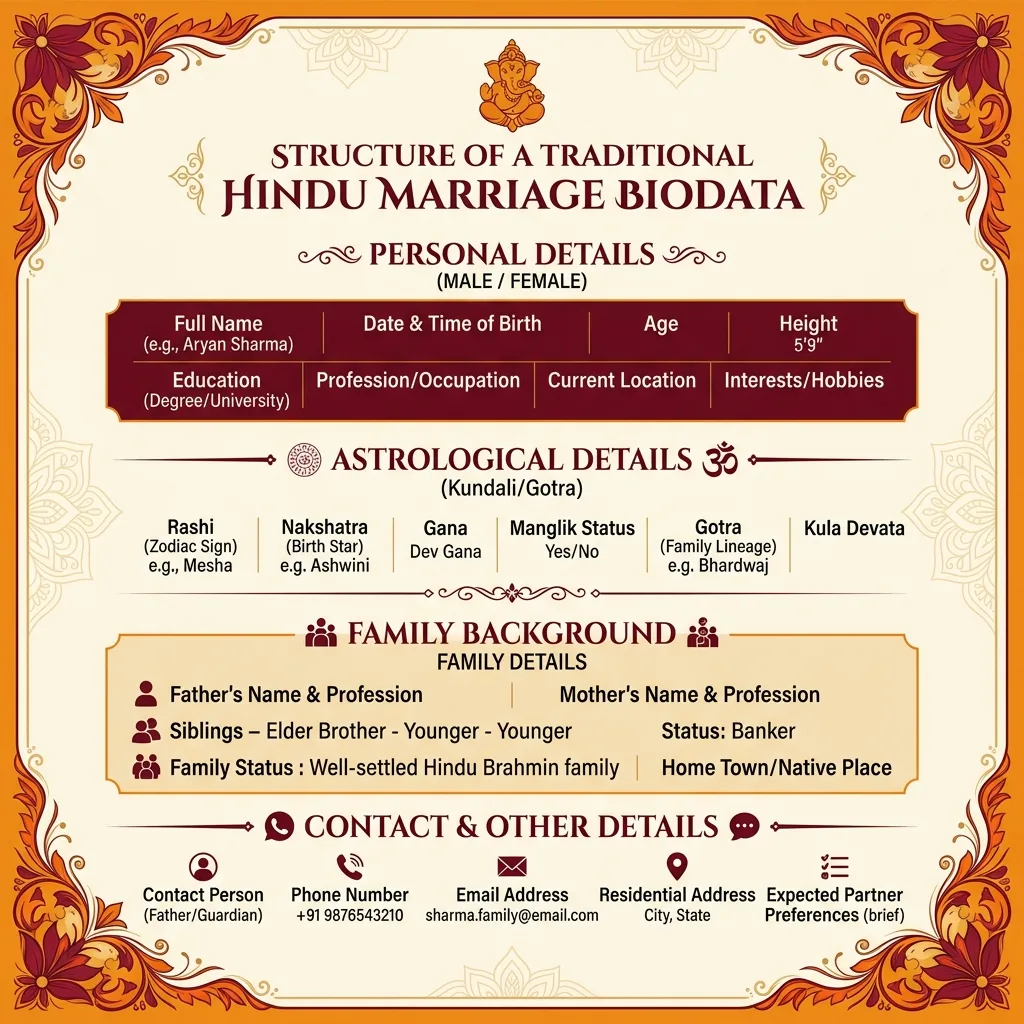
In the context of Indian arranged marriages, the marriage biodata is the very first impression two families share. For a Hindu family, this document is vastly different from a professional resume or a generic profile.
A Hindu marriage biodata differs primarily in two areas: astrological depth and community identity markers. Hindu families—across all regions and castes—routinely check Kundali (horoscope) compatibility before agreeing to a physical meeting. This makes the astrological section the most critical part of the document.
Culturally, traditional Hindu biodatas also include auspicious openings (like "Shubh Vivah", "Jai Sri Krishna", or "Jai Mata Di") and deity icons (Ganesha, OM symbol, or Swastika) at the absolute top of the page. This signals respectful intent and adherence to family traditions.
2. Complete Hindu Biodata Field Guide
Missing a crucial field in your biodata will result in immediate follow-up questions from the opposite family, delaying the process. Here is the definitive list of what must be included.
| Section | Fields to Include | Hindu-Specific Note |
|---|---|---|
| Auspicious Opening | Deity icon + heading | OM / Ganesha / Swastika — highly expected in traditional biodatas |
| Personal Details | Name, DOB, height, blood group | Include complexion only if your specific community expects it |
| Astrological / Religious | Rashi, Nakshatra, Gotra, Gana, Manglik | The absolute most critical section — never leave this blank |
| Birth Details | Date, Time, Place of Birth | Required for Kundali casting by the family priest — time is crucial |
| Caste / Community | Religion, Caste, Sub-caste, Native State | Sub-caste is often as important as the primary caste in matchmaking |
| Education & Career | Degree, College, Designation, Income | State income as a range (e.g. ₹15 to ₹20 LPA) |
| Family Background | Father, Mother (name + occupation), Siblings | Include maternal side (Mama) for North Indian communities |
| About Me & Hobbies | Personal statement + interests | Add a genuine line about balancing modern life with family values |
| Dietary Habits | Veg / Non-Veg / Jain Veg / Eggetarian | A hard filter for many conservative Hindu families |
| Expectations | Partner preferences | Keep to 2–3 honest, broad preferences rather than a rigid list |
| Contact Details | WhatsApp + email | State clearly whose number it is (Father, Mother, or Candidate) |
How to Phrase Your Details: Good vs. Bad Examples
While knowing what to include is important, how you write it matters just as much. The language used in a Hindu biodata should be clear, respectful, and unambiguous. Here are a few common pitfalls and how to correct them:
Vague & Confusing (Avoid)
- Diet: "Flexible" or "Mostly Veg" (Causes confusion for strict vegetarian families)
- Job: "Works in IT" (Too vague; doesn't indicate seniority or role)
- Manglik: Blank or "Not sure" (Forces the other family to consult a Pandit before proceeding)
- Caste: "Hindu" (In arranged marriages, parents need to know the specific community/sub-caste)
Clear & Respectful (Use This)
- Diet: "Strictly Vegetarian" or "Eggetarian" or "Non-Vegetarian"
- Job: "Senior Software Engineer at TCS (₹15–18 LPA)"
- Manglik: "Non-Manglik" or "Anshik Manglik (Pooja done)"
- Caste: "Hindu - Kanyakubja Brahmin" or "Hindu - Agarwal (Bansal Gotra)"
3. Astrological Details (The Hindu Core)
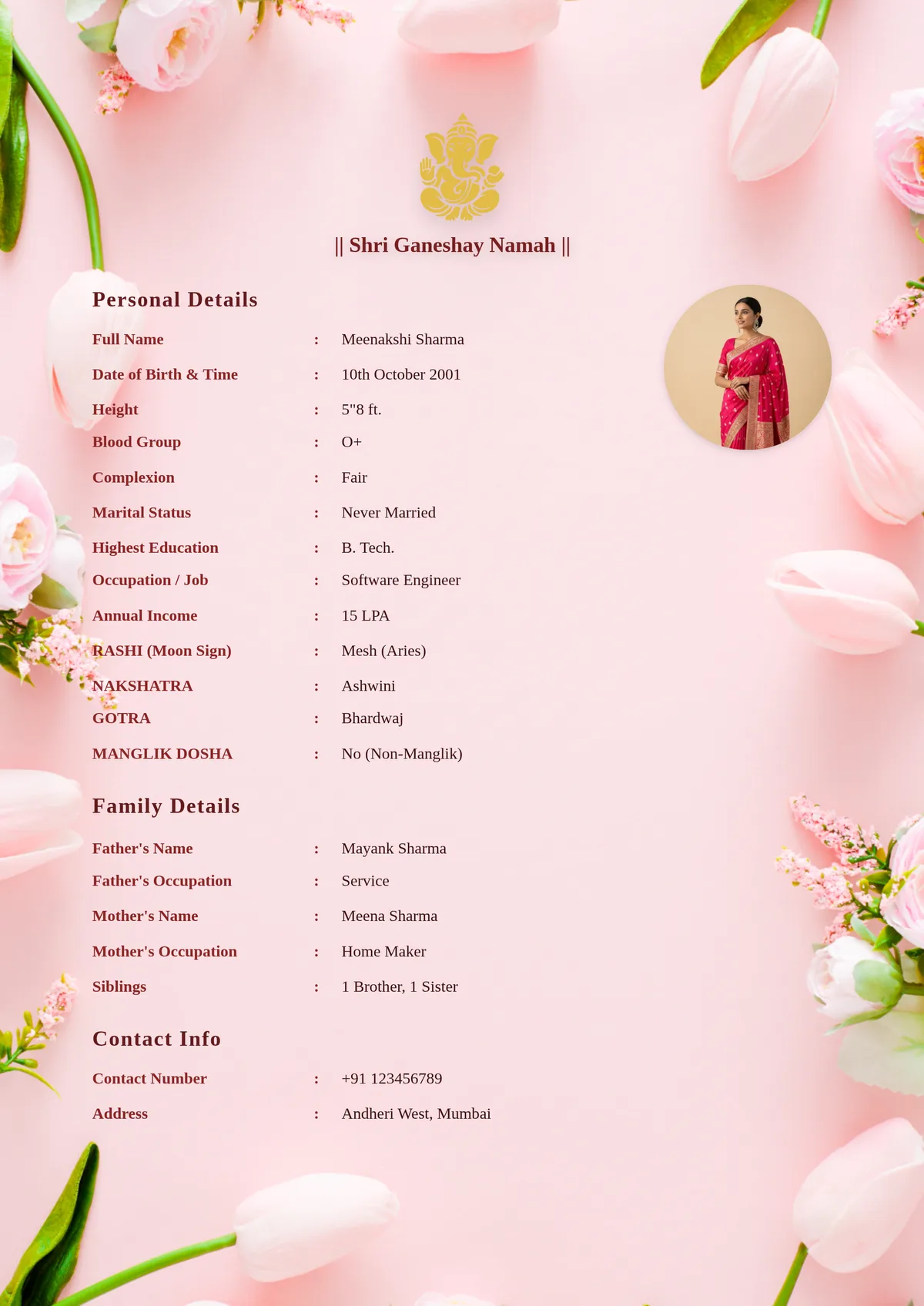
For a Hindu family, the astrological section is often checked before reading anything else. Many families will stop reading entirely if Gotra is blank or Manglik status is missing. Here is what each crucial field means:
Gotra (Lineage)
Indicates your patrilineal sage lineage. Prevents same-Gotra (Sagotra) marriages, which are strictly avoided in almost all Hindu communities to prevent inbreeding. Ask your parents if unsure; never guess.
Rashi (Moon Sign)
One of the 12 lunar zodiac signs (e.g., Mesha, Vrishabha). Used as the base for Ashtakoota (8-point) matching. A common first check before agreeing to share full Kundali charts.
Nakshatra & Pada
One of the 27 birth stars, divided into 4 quarters (Padas). Determines your Gana, which is a key parameter in the compatibility matching system.
Manglik / Kuja Dosha Status
Indicates the placement of Mars in your birth chart. You must state clearly: Manglik, Anshik Manglik, or Non-Manglik. Families generally prefer matching Mangliks with other Mangliks to neutralize the astrological effect.
Gana (Temperament)
Classified into three types: Deva (Divine), Manushya (Human), and Rakshasa (Demonic). It represents temperament and nature. Matching Ganas is considered crucial for psychological compatibility and harmony in marriage.
Lagna (Ascendant)
The zodiac sign rising on the eastern horizon at the exact time of birth. It represents the physical self and outward personality, playing a significant role in detailed Kundali matching, especially in South India.
Nadi (Pulse/Energy)
Categorised as Aadi, Madhya, or Antya. Nadi Dosha occurs when both partners share the same Nadi, which astrologically is believed to cause health and progeny issues. It carries the highest weightage (8 points) in Guna Milan.
Understanding Ashtakoot Guna Milan (36 Points)
When a family receives your biodata, the first thing the family priest (Pandit) will often do is calculate the Ashtakoot Guna Milan. This is an 8-point testing system that compares the bride and groom's birth charts to calculate a total compatibility score out of 36 points (Gunas).
Traditionally, a minimum score of 18 out of 36 is required for a marriage to be considered astrologically viable. The score evaluates factors like Varna (work compatibility), Vashya (dominance), Tara (destiny), Yoni (physical compatibility), Graha Maitri (mental compatibility), Gana (temperament), Bhakoot (love), and Nadi (health and progeny). Providing accurate birth details in your biodata ensures this calculation is done correctly from the start.
Pro Tip: For a complete breakdown of how to format these fields, read our Kundali details guide. If you are unsure about your Mars placement, read our Manglik biodata guide.
4. Regional Variations in Hindu Matchmaking
While the astrological foundation remains the same, India's diversity means that a Hindu biodata in Punjab looks very different from one in Tamil Nadu. Understanding these regional expectations is key to making a good impression.
| Region | Key Biodata Differences |
|---|---|
| North India (UP, Bihar, Rajasthan, MP) | Extended family section is heavily scrutinized. Expectation to list paternal grandfather, maternal uncle (Mama), and native village. Biraderi/Kul identity is prominent. |
| Maharashtra | Detailed Marathi community fields are required: Jati, Patkul, Devak, and native Taluka. See our Marathi biodata guide for specifics. |
| South India (Tamil, Telugu, Kannada) | Nakshatra Pada and Lagnam are absolutely mandatory for Ashtottara matching. Cheyvvai/Chevvai Dosham must be explicitly stated. Tamil: Iyer/Iyengar sub-sects and Gothram are critical. Telugu: Kamma/Reddy/Brahmin distinctions and native district carry heavy weight. |
| Punjab / Haryana | Sub-caste (Jat, Arora, Khatri, etc.) is the primary filter. Income and physical height are stated very prominently. Often includes detailed NRI/Visa status details. |
| Gujarat | Emphasis on Jnati (caste system) and Gana matching. Business and entrepreneurial background of the family is prominently noted. See our Gujarati biodata guide. |
| East India (Bengal, Odisha, Assam) | Heavy emphasis on cultural upbringing, education, and the arts. A Bengali biodata often highlights musical training, literature interests, and specific ancestral origin (Ghoti vs. Bangal) alongside standard Gotra. |
| Rajasthan / North India (Rajput / Kshatriya) | Clan lineage (Vansh) and Sub-clan (Shakha) are mandatory — e.g., 'Rajput (Chauhan Vansh), Jodhpur'. Opening headers like 'Jai Mata Di' and shield/sword motifs are common. Property or agricultural land background, NRI status, and income are stated prominently. Maternal lineage (Nani ka gaon) is frequently noted. Sample caste entry: 'Hindu — Rajput (Rathore Vansh), Rajasthan'. |
5. The Importance of Family Background (Kul / Khandaan)
In Hindu matchmaking, marriage is rarely seen as a union of just two individuals; it is fundamentally a union of two families. Therefore, the family background section is scrutinized just as closely as the individual's personal details.
A well-structured family section provides the opposite family with an immediate sense of your cultural roots, social standing, and upbringing. Here is how to format it effectively:
Grandparents (Paternal & Maternal)
Traditionally, listing the names of paternal grandparents (Dada/Dadi) is highly recommended. It establishes your Khandaan or lineage. In some communities (especially in North India and Rajasthan), listing maternal grandparents (Nana/Nani) and their native village is also expected, as it verifies the mother's lineage.
The Role of the Maternal Uncle (Mama)
Particularly in North Indian (UP, Bihar, Punjab) and Gujarati communities, the maternal uncle (Mama) plays a significant role in wedding rituals (like Bhaat). Mentioning his name and profession adds an extra layer of social validation and transparency.
How to List Siblings
When listing brothers and sisters, always mention their marital status. If they are married, it is considered polite and transparent to briefly mention the spouse's profession or family name. For example:
- Elder Brother: Rahul Sharma (Married to Priya Sharma, IT Consultant at Wipro)
- Younger Sister: Sneha (Unmarried, pursuing MBA)
By providing this context, you save the other family from having to ask awkward probing questions later, thereby building trust right from the start.
6. Balancing Tradition with Modern Expectations
Today's Hindu professionals often face a dilemma: how do you express a desire for an equal, progressive partnership while still showing respect for traditional family structures? The answer lies in the "About Me" and "Partner Expectations" sections.
A well-crafted "About Me" bridges both worlds. For example, instead of just saying "I am a modern guy," you can write: "I am career-driven and value a modern outlook on life, but I am deeply grounded in our family traditions and festivals." This tells parents you respect their values, while telling the prospective partner that you have a contemporary mindset.
Sample Progressive Expectation:
"Looking for an educated, independent partner who views marriage as an equal partnership. Someone who wishes to pursue her career after marriage will find full support from me and my family. We value mutual respect, shared responsibilities, and a healthy balance between modern lifestyles and our cultural roots."
7. Common Mistakes to Avoid in a Hindu Biodata
Even with the right template, small errors can lead to misunderstandings or prompt families to reject a profile prematurely. Avoid these common pitfalls:
- Guessing Astrological DetailsIf you don't know your Nakshatra or Gotra, do not guess or pick one randomly online. Write "To be confirmed" or leave it blank. Incorrect Gotras can lead to accidental Sagotra match approvals, which are later cancelled.
- Cluttered Family SectionsWhile family background is important, do not list every single aunt, uncle, and cousin. Stick to parents, grandparents, and siblings. Keep it to one page.
- Overly Casual LanguageAvoid slang or dating-app terminology (e.g., "Looking for someone to travel the world with"). Remember that parents and elderly matchmakers will read this first. Keep the tone respectful and grounded.
- Forgetting the Deity Icon (Traditional Families)If you are sending the biodata to very conservative elders or tier-3 city families, a plain, corporate-looking resume without a "Shree Ganeshay Namah" or Swastika might be perceived as "too westernized."
8. Traditional vs. Modern Design Choices
When building your biodata, you will have to choose between a traditional or modern format. Neither is wrong, but you should choose based on the type of family you are sending it to.
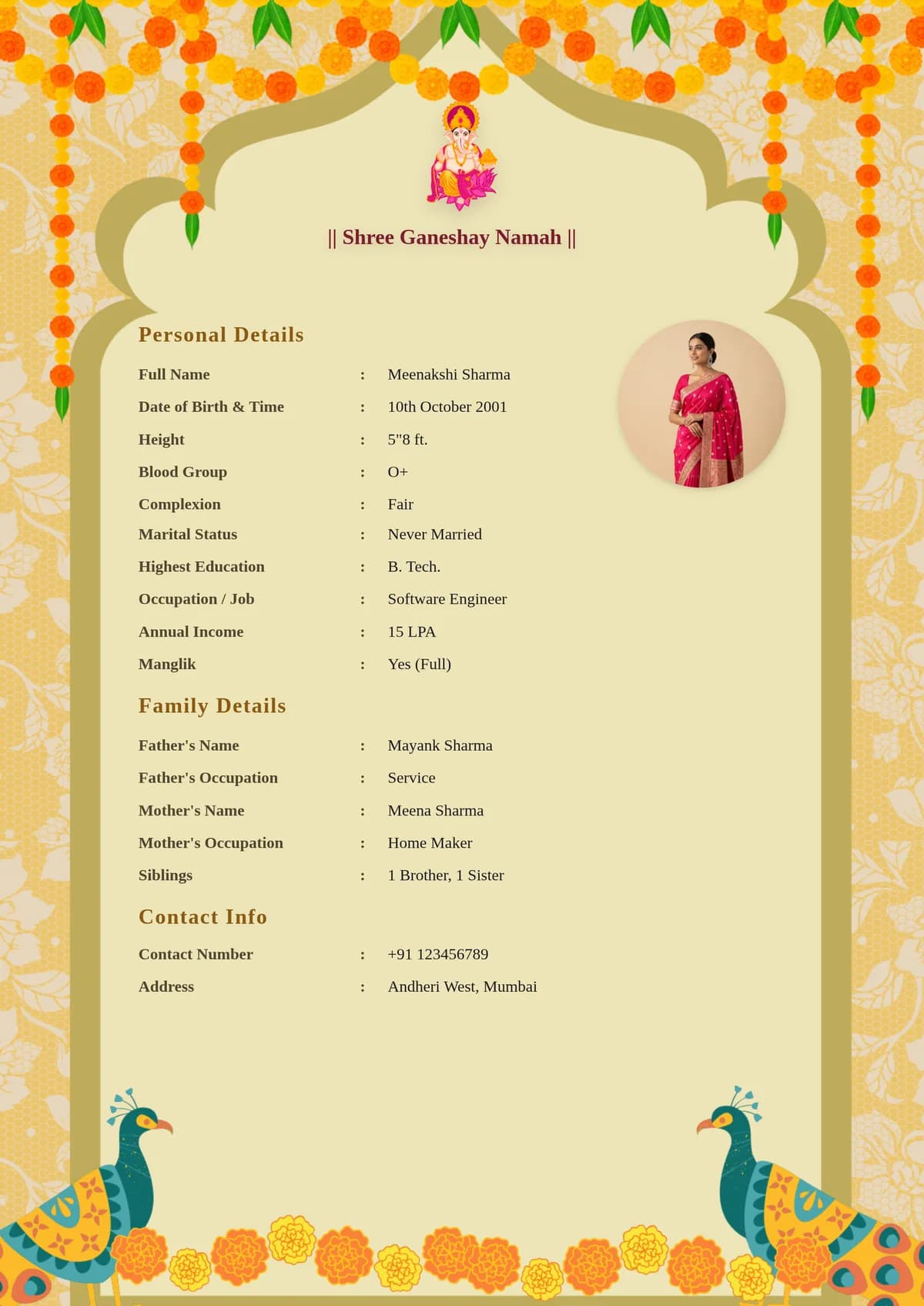
The Traditional Approach
- Features ornate, warm designs with floral or mandala borders.
- Uses saffron, deep maroon, and gold colors.
- Includes a prominent deity icon (Ganesha/Swastika) at the top.
- Best suited for conservative families, religious communities, or tier-2/3 city matches where respect for elders is the primary filter.
The Modern Approach
- Features clean, minimalist layouts akin to a premium resume.
- Uses neutral colors (navy blue, grey, pastel tones) with plenty of whitespace.
- Focuses heavily on the "About Me" section and career trajectory.
- Best suited for urban professionals, NRI matches, and self-arranged marriages where the couple interacts directly.
The Hybrid Solution: The most successful format today is a hybrid — a clean, modern visual layout that still rigorously includes all the traditional astrological and Gotra fields required by the parents.
9. How to Create Your Hindu Biodata Online
- Use a Dedicated Builder: Don't struggle with Word templates where the formatting breaks. Go to BiodataBuilder.in/create.
- Fill the Astrological Block: Toggle the astrology section on. Input your Date, Time, and Place of birth accurately. Add your Gotra, Rashi, and Manglik status.
- Select a Template: Choose between a traditional layout (with a Ganesha icon and warm borders) or a clean modern layout.
- Download PDF: Click download to get a high-quality PDF that you can immediately send via WhatsApp or email.
10. Frequently Asked Questions
What astrological details should a Hindu marriage biodata include?
A Hindu biodata must include: Date, Time, and Place of Birth (for Kundali), Rashi (moon sign), Nakshatra and Pada, Gotra (patrilineal lineage), Manglik Status (Manglik/Anshik/Non-Manglik), and optionally Gana, Lagna, and Nadi.
What makes a Hindu biodata different from other biodatas?
A Hindu biodata places far greater emphasis on astrological and community identity: Gotra matching, Manglik status, Rashi compatibility, and Gana are all checked before families agree to meet. Design-wise, it often includes auspicious symbols (OM, Ganesha) and headings.
What template design is best for a Hindu marriage biodata?
Traditional Hindu biodatas use warm, ornate designs with floral borders and a deity icon. Modern Hindu families increasingly prefer clean, minimalist layouts that still include all the astrological fields.
Are there regional differences in Hindu biodata formats?
Yes. North Indian biodatas often include a longer family section (including maternal family). South Indian biodatas emphasise Nakshatra Pada and Lagnam. Marathi biodatas use specific Marathi community fields like Patkul and Devak.
What if I don't know my exact time of birth for the Kundali?
If the exact time is unknown, you can mention an approximate time (e.g., 'Early morning, around 5:30 AM') or state 'Time unknown'. In such cases, families often rely on Rashi or Name-based matching instead of a full Kundali check.
How should I list my caste if my parents had an inter-caste marriage?
You can respectfully state both or list the father's caste, which is traditionally followed in patrilineal systems. For example: 'Hindu (Father: Brahmin, Mother: Rajput)'. Honesty upfront prevents complications later.
Should I include my salary if I am a Hindu bride?
Yes, modern biodatas for working brides frequently include salary (often as a range). It sets clear expectations about lifestyle and career ambitions, helping filter out families who may prefer a non-working daughter-in-law.
Conclusion
A strong Hindu marriage biodata bridges the gap between modern professional achievements and deep-rooted cultural traditions. By ensuring that your astrological fields (Gotra, Rashi, Manglik status) are completely accurate, and by formatting the document respectfully, you significantly increase the chances of finding a compatible match for your family.
Create Your Hindu Marriage Biodata — Free
Traditional or modern design — with all astrological fields, deity icon, and community details. Perfect PDF in minutes. No sign-up required.
Create Hindu Biodata FreeWhat to Read Next
Ready to create your biodata?
Use our free builder to make a WhatsApp-ready marriage biodata PDF in minutes.
Open free biodata maker