Rajan Kumar
Founder, BiodataBuilderRajan built BiodataBuilder to help millions of Indians create professional marriage biodatas easily. With expertise in Indian matrimonial traditions and 2M+ biodatas created on the platform, his guides cover every regional format, community custom, and modern best practice.
Last Updated:
Kundali Details in Marriage Biodata: What to Include
TL;DR - The Quick Summary
- The Foundation: Accurate Date, Time, and Place of birth are absolutely mandatory. Without these, a family astrologer cannot cast your Kundali.
- The Big Five: Your biodata must clearly list your Rashi (Moon Sign), Nakshatra (Birth Star), Gotra (Lineage), and Manglik Status.
- Honesty is Key: If you do not know your exact birth time, write "Time Unknown." Guessing leads to mismatched charts and creates distrust later in the process.
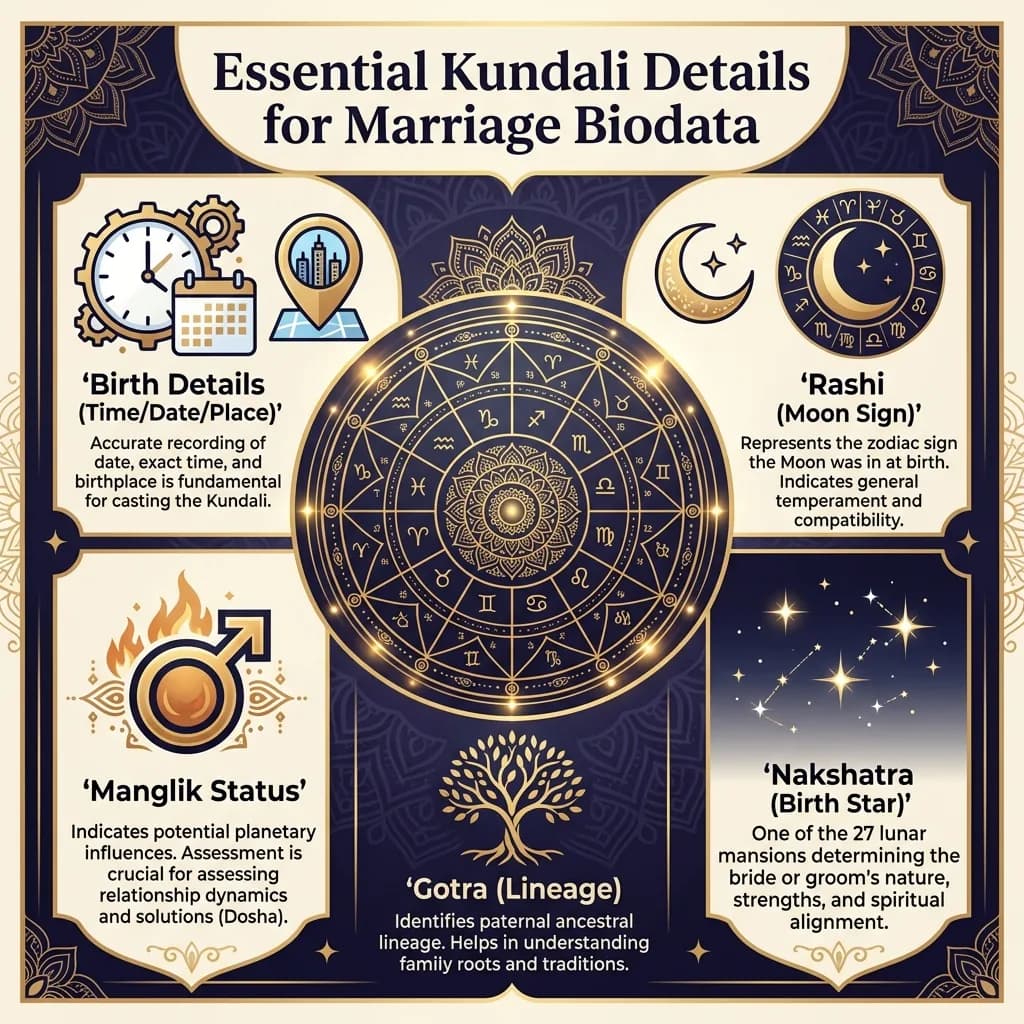
When creating the best marriage biodata format for a Hindu, one section stands above the rest in its ability to make or break an alliance: the Astrological or Kundali details.
For millions of families across India, Kundali matching (also known as Jyotish or Vedic astrology compatibility) is the very first filter. According to recent marriage biodata statistics, over 65% of traditional families will not proceed to a physical meeting without first verifying Guna Milan (the 36-point compatibility system). By proactively including accurate horoscope details in your biodata for marriage, you save everyone time and demonstrate respect for traditional processes.
2. Quick Reference: Essential vs Optional Fields
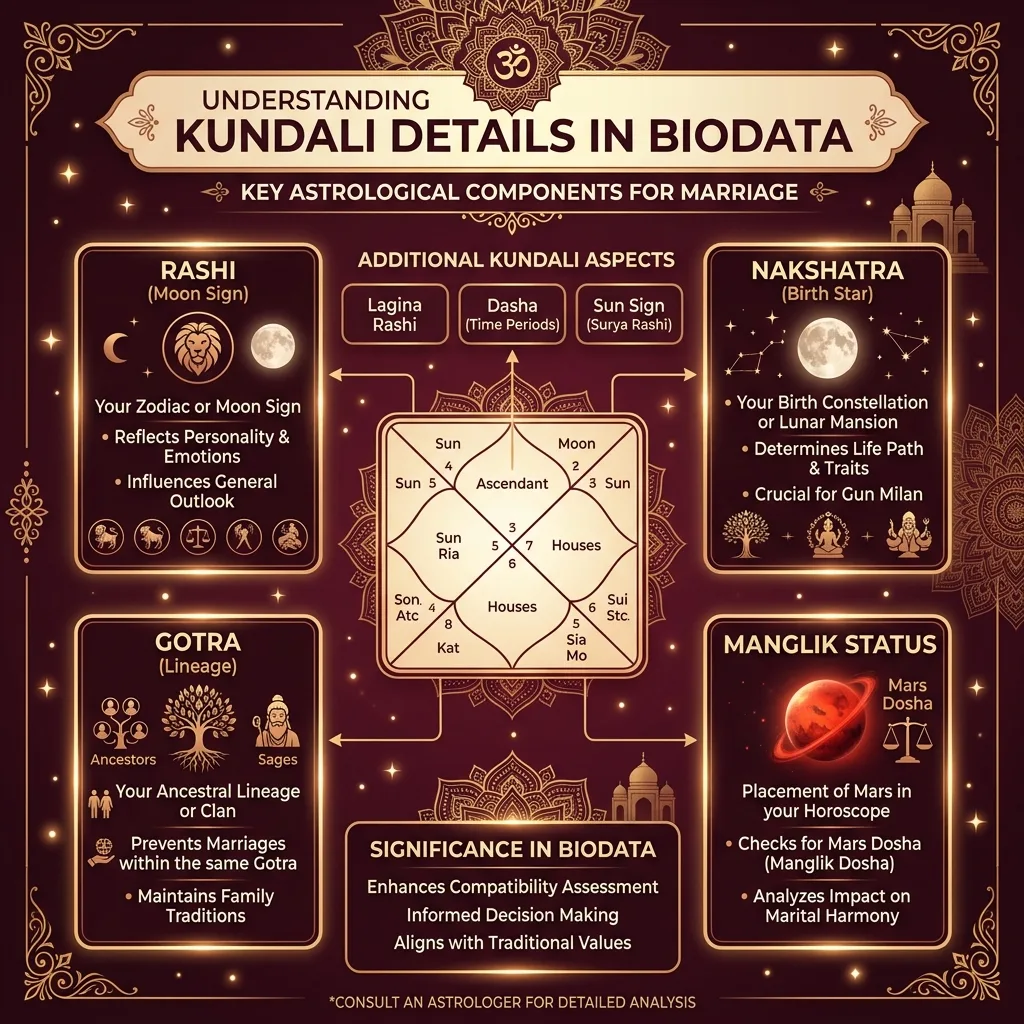
Not all astrological details carry the same weight. Here is a breakdown of what you must include versus what is merely helpful.
| Astrological Field | Importance | Example to Write |
|---|---|---|
| Date of Birth | ✅ Mandatory | 14 March 1996 |
| Time of Birth | ✅ Mandatory | 11:32 AM (or 'Unknown') |
| Place of Birth | ✅ Mandatory | Pune, Maharashtra |
| Rashi (Moon Sign) | ✅ Essential | Karka (Cancer) |
| Nakshatra & Pada | ✅ Essential | Pushya, 2nd Pada |
| Gotra | ✅ Essential | Kashyap |
| Manglik Status | ✅ Essential | Non-Manglik |
| Gana | ⭐ Optional | Deva |
| Lagna (Ascendant) | ⭐ Optional | Simha (Leo) |
Note: If you provide accurate Date, Time, and Place of birth, a family astrologer can calculate all the other fields. However, pre-filling Rashi, Nakshatra, Gotra, and Manglik status allows families to do a quick manual check before engaging their priest.
3. Deep Dive: Birth Details & Rashi
Date, Time, and Place of Birth
This triad forms the mathematical foundation of your entire astrological chart. A difference of even 5 minutes in your birth time can shift your Lagna (Ascendant) or Nakshatra Pada, completely altering your Kundali matching results. Always write it out clearly:
- Format the Date: Use clear formatting like "14 March 1996" rather than "14/03/96" (which can be confused with American date formatting).
- Include AM/PM: Never write just "11:32" — specify AM or PM, or use the 24-hour clock (e.g., 23:32).
- Place of Birth: Include both the City and the State, especially if the city is small or has a common name (e.g., "Aurangabad, Maharashtra" vs "Aurangabad, Bihar").
Rashi (The Moon Sign)
Your Rashi is the zodiac sign in which the Moon was positioned at the exact moment of your birth. Unlike Western astrology, which relies on Sun signs, Vedic astrology relies heavily on the Moon sign for matchmaking. There are 12 Rashis (e.g., Mesh/Aries, Karka/Cancer, Tula/Libra).
Many families perform a preliminary check known as "Bhakoot" based purely on the boy and girl's Rashis before even running a full Kundali calculation.
4. Deep Dive: Nakshatra, Gotra, and Manglik Status
Nakshatra & Pada (Birth Star)
The Vedic sky is divided into 27 lunar mansions called Nakshatras. Your Nakshatra determines your starting planetary period (Dasha) and heavily influences your basic temperament. Furthermore, each Nakshatra is divided into 4 quarters called Padas.
When listing your Nakshatra in your biodata, try to include the Pada if you know it (e.g., Pushya, 2nd Pada). This level of detail shows the receiving family that you are prepared and respect the process.
Gotra (Ancestral Lineage)
Gotra traces your patrilineal descent back to an ancient Vedic sage (Rishi). In almost all traditional Hindu communities, Sagotra marriages (marrying someone of the exact same Gotra) are strictly prohibited, as it is considered akin to marrying a sibling. Therefore, explicitly stating your Gotra (e.g., Kashyap, Bharadwaj, Vatsa) immediately clears this primary filter.
Note: Certain regional formats, such as the Gujarati lagna biodata format, place extremely high importance on Gotra alongside Jnati (sub-caste).
Manglik Status (Mangal Dosha)
Mangal Dosha occurs when the planet Mars (Mangal) is placed in the 1st, 4th, 7th, 8th, or 12th house of the Kundali. It is arguably the most scrutinised aspect of a marriage biodata. You must state your status transparently as one of three options:
- Manglik (Full Mangal Dosha)
- Anshik Manglik (Partial / Low Mangal Dosha)
- Non-Manglik (No Mangal Dosha)
If you are Manglik, do not hide it. Traditional guidance recommends that Mangliks marry other Mangliks, effectively neutralizing the Dosha. For a comprehensive look at how to structure your biodata if you have this placement, read our Manglik Biodata Format guide.
5. Advanced Fields (Gana, Lagna, Nadi)
While not strictly mandatory, including these advanced fields indicates a high level of preparation, especially in traditional families:
- Gana: Derived from your Nakshatra, humans are categorised into three temperaments: Deva (Divine), Manushya (Human), and Rakshasa (Demonic). Gana matching ensures temperament compatibility.
- Lagna (Ascendant): The zodiac sign rising on the eastern horizon at the exact moment of birth. It represents the physical self and outer personality.
- Nadi: There are three Nadis: Aadi, Madhya, and Antya. Nadi matching carries the highest points (8 out of 36) in Ashtakoota Milan and is believed to govern physiological and genetic compatibility. Marrying someone with the same Nadi (Nadi Dosha) is generally avoided.
6. What If You Don't Know Your Birth Time?
Honesty is the Best Policy
Never guess your birth time or write a generic time like "12:00 PM" just to fill the field. If your parents only remember an approximate time, write it as "Approx. 2:00 PM - 3:00 PM."
If it is entirely unknown, write "Time Unknown." Many experienced astrologers can still perform partial matching based on Rashi and Nakshatra alone, or they can use alternative astrological methods (like Prashna Kundali or name-based matching) to assess compatibility.
7. Manglik Myths & Biodata Etiquette
In Indian matchmaking, there is significant anxiety surrounding the "Manglik" label. If you are preparing a second marriage biodata or standard format, it's crucial to handle this section maturely.
Myth: Being Manglik is bad luck.
Reality: It simply means you have strong Mars energy (associated with independence, passion, and assertiveness). Astrologically, it is balanced by marrying another person with similar Mars energy.
When sending your biodata via WhatsApp, do not preemptively defend or apologize for your Manglik status in the cover message. Simply list it objectively in the Kundali section and let the families' respective astrologers evaluate the charts. Often, planetary alignments like a strong Jupiter can cancel out Mangal Dosha completely (a phenomenon known as Dosha Parihara).
8. Sample Kundali Section
When formatting this section, present it clearly as a list or a table. Unlike the "About Me" section which requires descriptive paragraphs, the Kundali section should be purely factual data. Here is an example of a perfectly structured Kundali block:
Astrological Details
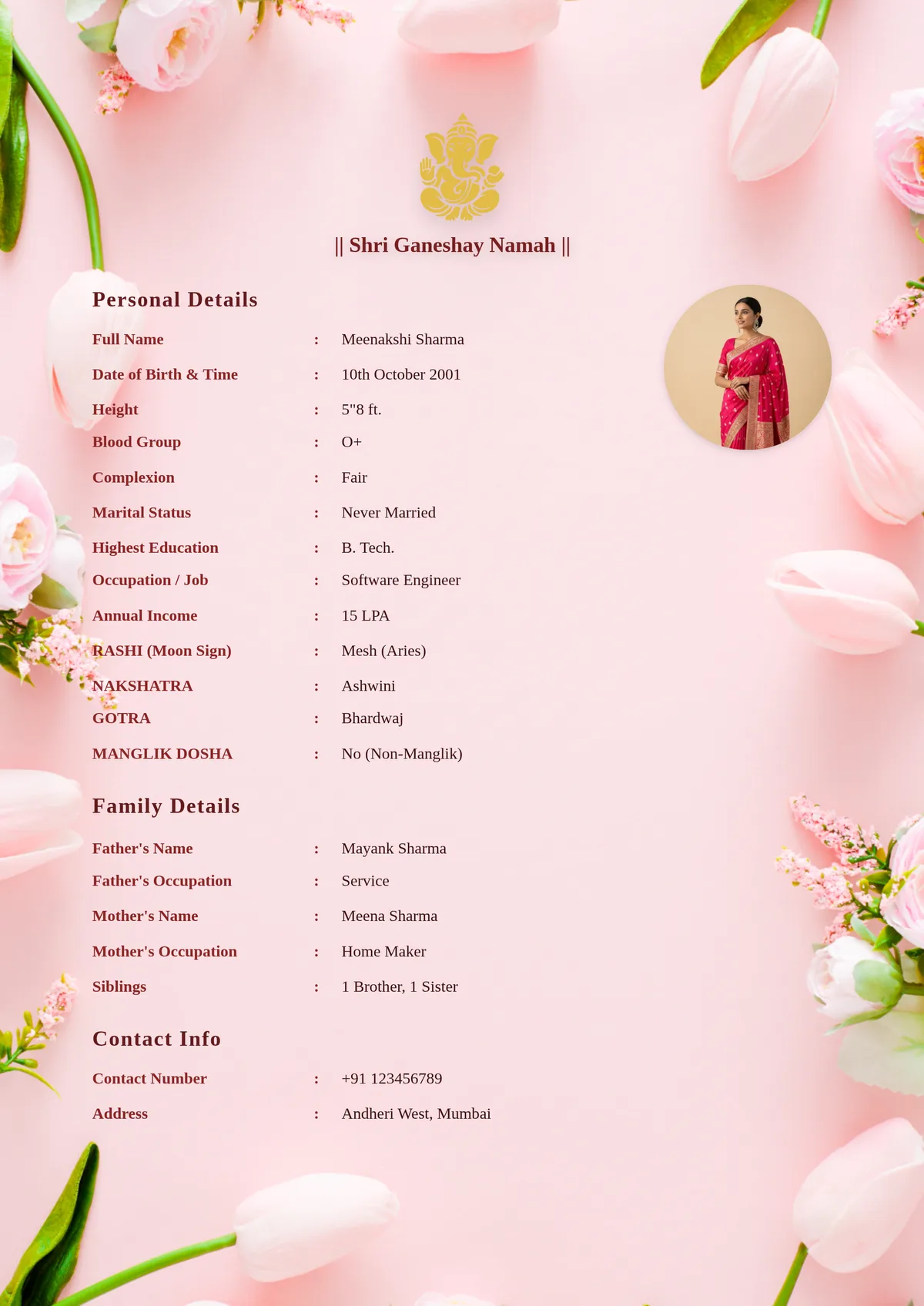
A complete, cleanly formatted Kundali section built using BiodataBuilder's templates.
Don't Miss a Single Field
Our automated builder ensures you include all the necessary astrological fields in a beautiful, structured format.
Start Building Now9. Frequently Asked Questions
What kundali details should be in a marriage biodata?
Include: Date, Time, and Place of Birth, Rashi (moon sign), Nakshatra and Pada, Gotra, and Manglik Status. Optionally, you can add Gana, Lagna, and Nadi for more complete matching information.
Is it necessary to include Kundali details?
For traditional Hindu families, yes. Kundali matching is central to the matchmaking process. Many families will not proceed to a physical meeting without confirming astrological compatibility first.
What is the difference between Rashi and Nakshatra?
Rashi is the moon sign (one of 12 zodiac signs). Nakshatra is the birth star (one of 27 lunar mansions). Your Nakshatra determines your Gana, which is heavily used in Ashtakoota matching.
What should I write if I don't know my birth time?
Write 'Birth time unknown' or 'Approx. 2:00 PM'. Do not guess — an incorrect birth time produces a wildly inaccurate Kundali. Many priests can still work with approximate times if you note them as approximate.
What does Manglik status mean in a biodata?
Manglik (Mangal Dosha) refers to Mars being placed in certain birth chart houses. State clearly: Manglik (Full), Anshik Manglik (Partial), or Non-Manglik. Traditional guidance recommends matching Mangliks with other Mangliks.
Conclusion
In the journey of arranged marriages, the Kundali section of your biodata is far more than just a list of planetary alignments; it is a signal of transparency, respect for tradition, and readiness for marriage.
By clearly listing your Rashi, Nakshatra, Gotra, and accurate birth details, you allow families to quickly ascertain compatibility. Even if you prefer a modern biodata format, retaining a clean and accurate astrological section ensures you don't alienate traditional matches.
Add All Astrological Details Easily
Our builder has dedicated fields for Rashi, Nakshatra, Gotra, Manglik status and more. Export a pristine, professional PDF in seconds.
Create Biodata FreeWhat to Read Next
Ready to create your biodata?
Use our free builder to make a WhatsApp-ready marriage biodata PDF in minutes.
Open free biodata maker