Rajan Kumar
Founder, BiodataBuilderRajan built BiodataBuilder to help millions of Indians create professional marriage biodatas easily. With expertise in Indian matrimonial traditions and 2M+ biodatas created on the platform, his guides cover every regional format, community custom, and modern best practice.
Last Updated:
Create Punjabi Marriage Biodata Online
(Free PDF)
Learn how to create a Punjabi marriage biodata that meets the expectations of Punjabi families. This guide covers Gotra, caste and community details, Sikh and Hindu traditions, NRI information, and provides free PDF templates for both boys and girls.
TL;DR - The Quick Summary
- State Caste & Sub-Caste Precisely: In many Punjabi families, mentioning only "Sikh" may not provide enough information. Families often also mention their community or background, such as Jat Sikh, Ramgarhia, Khatri, Arora, or Brahmin, depending on their traditions and preferences.
- NRI Status is a Top Filter: Punjab has one of the highest NRI populations in India. Whether you are in Canada, the UK, or Australia, this must appear prominently near the top of your biodata.
- Gotra is Non-Negotiable: For Hindu Punjabi and many Sikh families, Gotra (patrilineal clan) is checked before any meeting is arranged. Same-Gotra marriage is avoided.
- Include Language Preference: Mention whether you speak Punjabi, Hindi, or English fluently. Many Punjabi families consider language compatibility important, especially for NRIs.
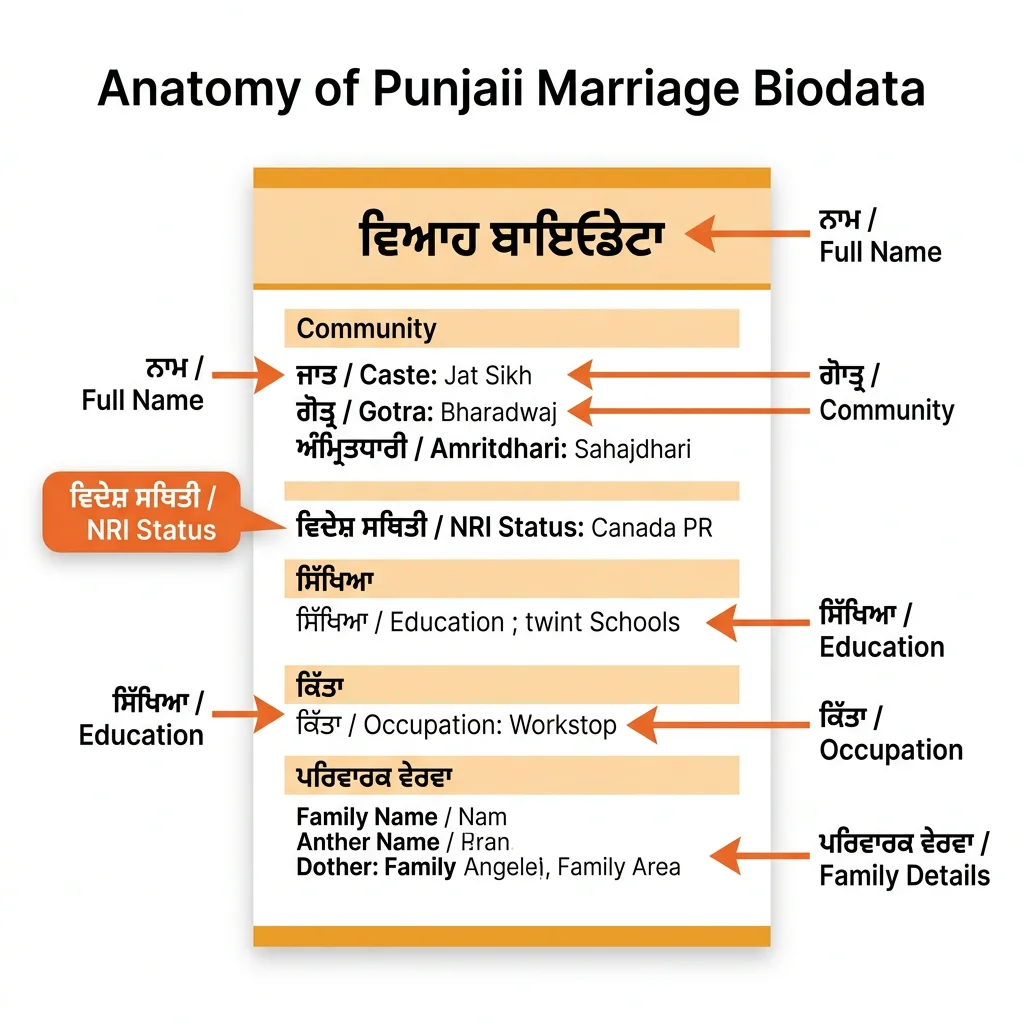
Punjab is a land of extraordinary cultural pride. From the vibrant energy of Baisakhi to the deep reverence for Waheguru, every aspect of Punjabi life is shaped by a fierce sense of identity and community. This is no different when it comes to matrimony. The Punjabi marriage biodata (ਵਿਆਹ ਬਾਇਓਡੇਟਾ) is not just a document — it is a family's introduction to the world, and it must be crafted with the same pride and precision that Punjabis apply to everything they do.
A generic Word document template fails Punjabi families because it simply does not account for the nuances that matter most: specific caste and sub-caste beyond just "Sikh" or "Hindu," Gotra for ancestral compatibility checks, NRI or abroad status (perhaps the single most searched filter in Punjab matrimony), and whether the candidate is Amritdhari. These fields are treated as non-negotiable primary filters before any further discussion takes place.
Punjab also has a uniquely global matrimonial landscape. According to Indian marriage biodata statistics, Punjab has one of the highest per-capita NRI populations of any Indian state, with large communities settled in Canada (particularly Brampton and Surrey), the UK (Birmingham and Southall), the United States, Australia, and the Middle East. This means a Punjabi biodata is frequently reviewed by families across multiple continents — making its clarity, formatting, and cross-cultural readability more critical than almost any other regional format.
Whether you are writing a biodata for a Punjabi boy in Chandigarh looking for a match in Vancouver, or a girl's biodata for a family in Ludhiana, this guide covers every field, every cultural expectation, and every formatting decision you need to make — so that the first impression you leave is the right one.
2. Field Mapping: English to Punjabi Scriptਵਿਆਹ ਬਾਇਓਡੇਟਾ – ਸਾਰੇ ਖੇਤਰ
Including Punjabi script (Gurmukhi) field labels alongside English text is a mark of cultural respect and makes your biodata instantly recognisable within the community. It also ensures clarity when the document is shared with elder family members in Punjab who may be more comfortable with Gurmukhi. Below is a complete field-by-field mapping:
| Field (Punjabi ਗੁਰਮੁਖੀ) | Field (English) | Example |
|---|---|---|
| ਨਾਮ | Full Name | Amritpal Singh Sandhu |
| ਜਨਮ ਮਿਤੀ | Date of Birth | 14 November 1996 |
| ਜਨਮ ਸਥਾਨ | Place of Birth | Ludhiana, Punjab |
| ਕੱਦ | Height | 5 ft 11 in |
| ਭਾਰ | Weight | 78 kg |
| ਧਰਮ | Religion | Sikh |
| ਜਾਤ | Caste / Community | Jat Sikh |
| ਗੋਤ੍ਰ | Gotra | Bharadwaj |
| ਅੰਮ੍ਰਿਤਧਾਰੀ | Amritdhari Status | Sahajdhari |
| ਵਿਦੇਸ਼ ਸਥਿਤੀ | NRI / Abroad Status | Canada PR – Brampton, ON |
| ਸਿੱਖਿਆ | Education | B.Tech (CS), Thapar University |
| ਕਿੱਤਾ | Occupation | Software Engineer, TCS Canada |
| ਸਾਲਾਨਾ ਆਮਦਨ | Annual Income | CAD 90,000 |
| ਪਿਤਾ | Father | Gurjant Singh Sandhu – Farmer, Ludhiana |
| ਮਾਤਾ | Mother | Paramjit Kaur Sandhu – Homemaker |
| ਭੈਣ-ਭਰਾ | Siblings | 1 Elder Sister (Married, UK) |
| ਪਰਿਵਾਰ ਦੀ ਕਿਸਮ | Family Type | Nuclear – Ludhiana (India) |
| ਸੰਪਰਕ | Contact | +91-98760-XXXXX (Father) |
Tip: When using our biodata generator, you can type these exact Punjabi Gurmukhi terms directly into the custom field label boxes to create a bilingual biodata.
Create Your Punjabi Biodata in Minutes
Our builder supports custom Gurmukhi field labels, NRI details, and Gotra fields. Download a beautiful, culturally-appropriate PDF instantly — free, no sign-up.
Create Biodata Now3. Caste, Sub-Caste & Sikh Community Identifiers
Of all the information on a Punjabi marriage biodata, caste and community is the one that receives the most scrutiny — and the most errors. Stating only "Sikh" or "Hindu" is one of the most common mistakes Punjabi families make when drafting a biodata, and it is also one of the primary reasons a profile gets skipped entirely during the initial shortlisting phase.
The Punjabi community is broadly divided into Sikh families and Hindu Punjabi families, and each of these contains distinct sub-communities with their own matrimonial networks, cultural practices, and social norms. Being specific is not about prejudice — it is about giving the other family the information they need to determine genuine compatibility.
Major Sikh Communities
- Jat Sikh: The largest Punjabi Sikh community, traditionally from farming and land-owning backgrounds. Dominant in rural Punjab, Haryana, and Malwa regions. High NRI concentration in Canada and the UK.
- Khatri (Sikh): Historically a merchant and warrior class. Associated with urban professions. Many Punjabi Sikh families in Delhi NCR are Khatri.
- Ramgarhia: Traditionally artisans and craftspeople (carpenters, blacksmiths, masons). Large diaspora in East Africa and the UK.
- Arora (Sikh): Trader and merchant community. Often from the western Punjab (now Pakistan) and settled in Delhi and Chandigarh.
- Ravidassia / Mazhabi Sikh: Communities from the Dalit Sikh tradition. Distinct matrimonial networks and should be stated explicitly.
Hindu Punjabi Communities
- Khatri (Hindu): The same ancestral community as Sikh Khatris but of Hindu faith. Prominent in Delhi, Chandigarh, and Himachal Pradesh.
- Arora (Hindu): Merchant class, closely related to Khatris. A very large community in Delhi NCR and Rajasthan border regions.
- Brahmin (Punjabi): Must specify Gaur Brahmin, Saraswat Brahmin, or Mohyal Brahmin — each is a distinct community with separate matchmaking networks.
- Bania / Mahajan: Trading community, often overlapping with Aroras. Should state sub-caste like Agarwal if applicable.
- Rajput (Punjabi): Found primarily in the Doaba region and foothills of Himachal. Sub-castes like Bhullar, Mann, and Gill are well-known.
The Amritdhari vs. Sahajdhari Distinction
For Sikh families, one additional field matters enormously: whether the candidate is Amritdhari (Khalsa-baptised, observing all Five Ks) or Sahajdhari (non-baptised, may or may not keep hair). A strictly Amritdhari family will typically only consider Amritdhari matches. This field should always be stated clearly and honestly.
How to Write It on Your Biodata
Religion: Sikh
Caste / Community: Jat Sikh
Gotra: Bharadwaj
Amritdhari: No (Sahajdhari)
What Different Punjabi Families Look For
| Community | Usually Included in Biodata |
|---|---|
| Sikh | Community, Amritdhari/Keshdhari (if relevant), NRI status |
| Hindu Punjabi | Gotra, caste/community, family background |
| NRI Punjabi | Country, PR/Citizenship, occupation, visa status (optional) |
Example of a Complete Profile:
Community: Jat Sikh
Gotra: Sandhu
Native Place: Ludhiana, Punjab
Current Residence: Brampton, Ontario, Canada
Occupation: Software Engineer
Common Mistake: Never write just "Sikh" as your only caste/community entry. This is the equivalent of a job resume saying "I am human." Without the sub-community, shortlisting families have no way to filter your profile for compatibility and will simply skip it.
4. Gotra (ਗੋਤ੍ਰ) — Why It Matters & How to Write It
In Indian matrimonial culture, Gotra refers to the patrilineal ancestral clan — the lineage traced back to a common male ancestor (often a Vedic rishi or sage). For Hindu Punjabi families, Gotra is an absolute prerequisite: two people from the same Gotra are considered siblings by lineage, and Sagotra (same-Gotra) marriage is strictly prohibited across almost all Hindu Punjabi communities.
For Punjabi Sikh families, the situation is more nuanced. Sikhism, in its scriptural form, does not endorse the caste or Gotra system. However, in practice, many Jat Sikh families still check Gotra (sometimes called Kul or Got) as an ancestral filter, particularly in rural Punjab and Haryana. Families from Khatri Sikh or Arora backgrounds also frequently observe this tradition. Urban and educated Sikh families in Chandigarh and Delhi NCR may place less emphasis on it, but it is always safer to include your Gotra than to leave it blank — a missing Gotra entry can cause a family to pause and ask, which delays the process.
Common Punjabi Gotras
Jat Sikh Gotras & Family Surnames
Jat Sikh families also use surnames as an informal Gotra indicator. Common Jat Sikh surnames like Sandhu, Sidhu, Gill, Dhaliwal, Grewal, Bajwa, and Cheema often correspond to specific ancestral clans. Some families treat the surname itself as equivalent to a Gotra for the purpose of determining permissible matches. If you are from a Jat Sikh background, stating your full surname alongside your Gotra removes all ambiguity.
Religion: Sikh (Jat)
Gotra / Kul: Bharadwaj
Family Surname: Sandhu
Native Village: Sandhu, Mansa District, Punjab
Not sure of your Gotra? Ask your grandparents or the family pundit. For a detailed explanation of why Kundali and ancestral details matter in biodata, read our dedicated guide.
5. NRI & Abroad Status — The Most Important Field in a Punjabi Biodata
No guide to Punjabi marriage biodatas would be complete without a thorough look at the NRI factor. Punjab consistently ranks as India's number one state by per-capita NRI population. Entire districts — Jalandhar, Hoshiarpur, Doaba region — have such high emigration rates that they have earned the informal title of "NRI belt." The result is a matrimonial culture where abroad status is not just a detail; it is frequently the primary search filter families apply before reading anything else on a biodata.
This creates a very specific responsibility for the biodata writer. If you live abroad, you must provide precise, honest details. If you live in India, you must not obscure or hide this fact — doing so leads to immediate loss of trust the moment it is discovered. Either way, the abroad/NRI section should be clear, front-loaded, and complete.
What to Include if You Are an NRI
Simply writing "NRI" or "Settled Abroad" is not enough. Whether you are in Canada, the UK, Australia, the USA, or New Zealand, Punjabi families want precise information on all four of the following points:
1. Country & City
Not just "Canada" — specify the city (Brampton, Surrey, Calgary) or country (UK, Australia, USA, New Zealand). Different cities have different Punjabi community concentrations.
2. Visa / Immigration Status
PR (Permanent Resident), Citizenship, Work Permit, H1B (USA), Tier 2 (UK), or Student Visa. This determines settlement stability.
3. Years Abroad
"Recently moved" (1-2 years on work permit) vs. "settled for 10+ years with citizenship" are very different situations for families.
4. Return to India Plans
If you plan to settle abroad permanently, or prefer the candidate also relocates abroad, state this clearly in the Expectations section.
NRI Boy Biodata — Sample Snippet
Name: Manpreet Singh Dhaliwal
Date of Birth: 22 August 1994
Religion / Caste: Sikh (Jat Sikh)
Gotra: Kashyap
Amritdhari: No (clean-shaven)
Country of Residence: Canada (Brampton, Ontario)
Immigration Status: Canadian Permanent Resident
Years in Canada: 6 Years
Education: B.Tech (Mechanical Eng.), PTU Jalandhar
Occupation: Truck Owner-Operator (Self-Employed)
Annual Income: CAD 1,10,000 approx.
Family in India: Hoshiarpur, Punjab (Father – Retired Govt. Employee, Mother – Homemaker, 1 Younger Brother – Engineering Student)
Expectation: Looking for a well-educated Jat Sikh girl, willing to settle in Canada.
NRI Girl Biodata — Sample Snippet
Name: Gurpreet Kaur Brar
Date of Birth: 5 March 1997
Religion / Caste: Sikh (Jat Sikh)
Gotra: Vashisht
Country of Residence: United Kingdom (Birmingham)
Immigration Status: British Citizen (Born in UK)
Education: BSc (Nursing), University of Birmingham
Occupation: Staff Nurse, NHS – Birmingham Royal Hospital
Annual Income: GBP 36,000
Family: Parents reside in Jalandhar, Punjab. Elder brother settled in Birmingham.
Expectation: Looking for a Jat Sikh boy, preferably settled in the UK or open to relocating.
Do Not Hide Your India Status: If you live in India, do not imply you are abroad or leave the field blank hoping the question won't be asked. Punjabi families almost always ask about abroad status within the first contact. Being transparent about living in India, especially if you have a strong career and family background, builds far more trust than a biodata that seems evasive.
Ready to Build Your Punjabi Biodata?
Our builder auto-formats NRI details, Gotra, and caste fields perfectly. No table alignment nightmares, no broken Word layouts — just a beautiful PDF in minutes.
Start Building Now6. Punjabi Boy Biodata Example
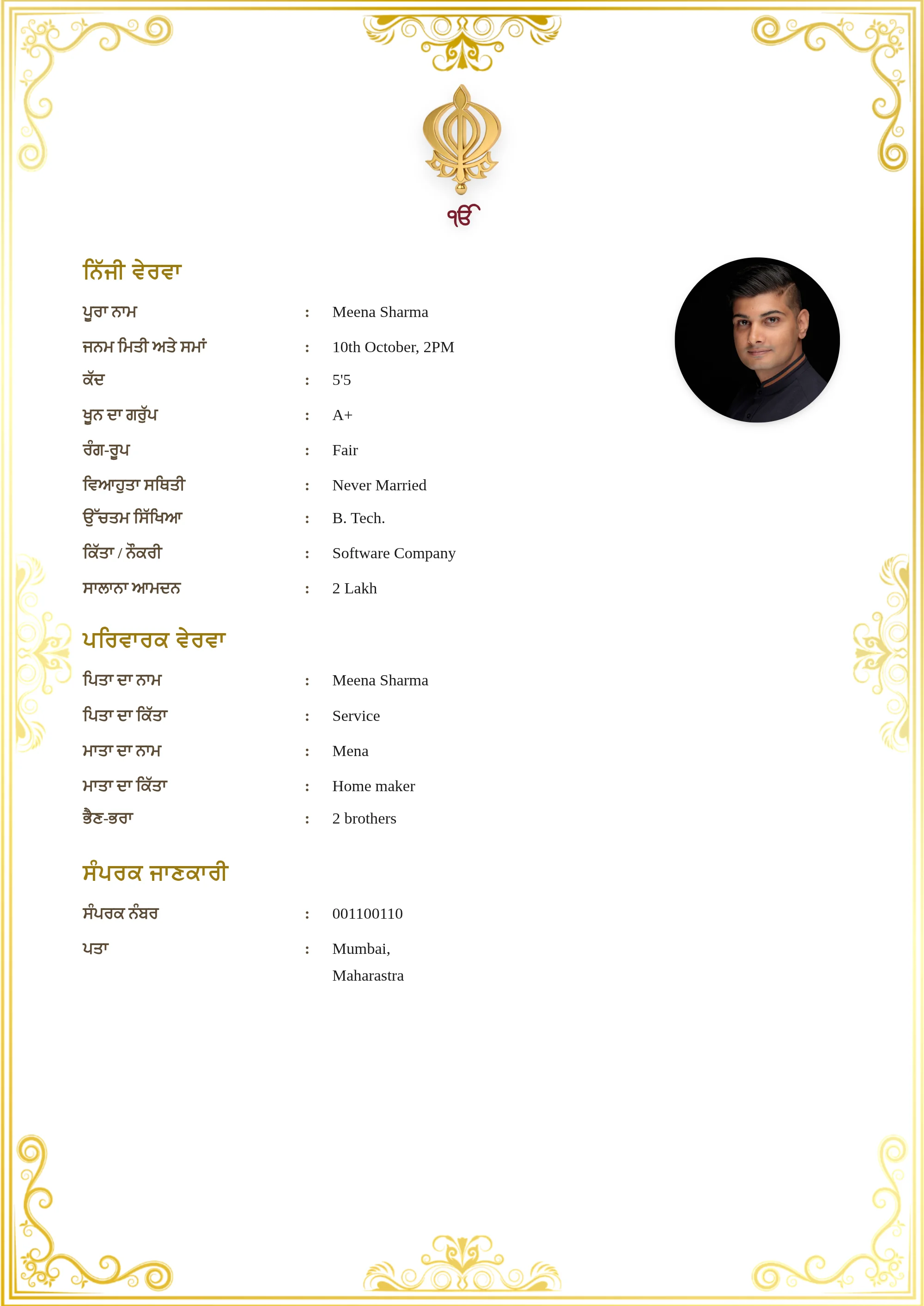
When creating a marriage biodata for a Punjabi boy, the primary expectation from Jat Sikh and Khatri families is a clear display of career stability, income, and — if applicable — NRI or abroad status. Unlike other communities where family lineage is the opening statement, many Punjabi families read the boy's education, occupation, and income first.
A strong Punjabi boy's biodata should also address the family's agricultural or business background if relevant. Families from Jat communities often mention land ownership in Punjab (e.g., "5 acres agricultural land, Ludhiana") as it communicates financial stability and roots. If the boy is based in India but his siblings are abroad, this should also be mentioned as it signals the family has an international network.
For a boy who is in India with a strong private-sector job but no NRI status, the key is to lead with career achievements. A detailed entry like "Software Engineer, Infosys Chandigarh, CTC ₹18 LPA" is far more compelling than "Software Engineer." Be specific, because the family reviewing your biodata is comparing it against dozens of others in the same session.
7. Punjabi Girl Biodata Example
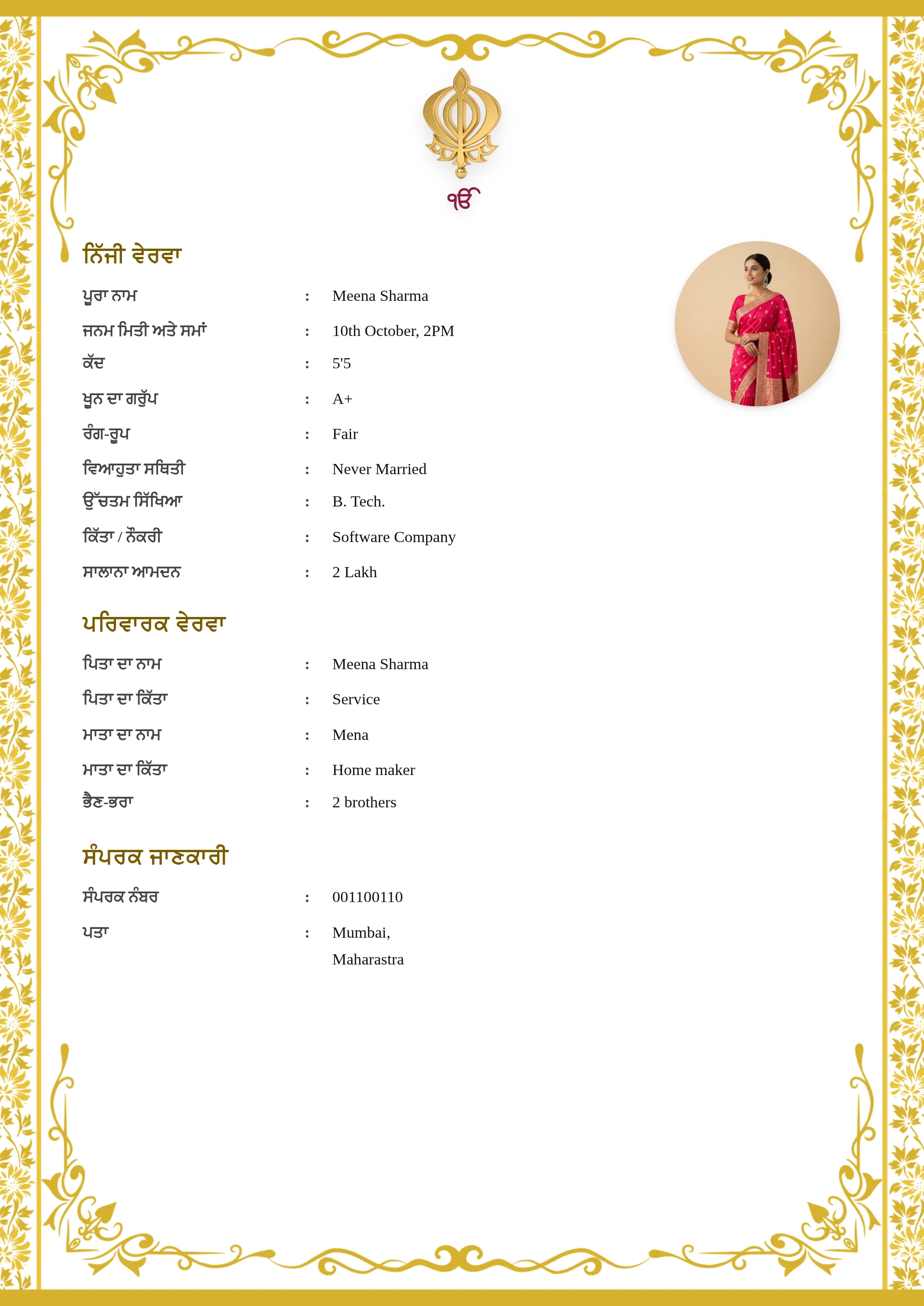
For a Punjabi girl's shaadi biodata, the modern Punjabi family — particularly from urban Chandigarh, Delhi NCR, or the diaspora — values education and career just as much as traditional family values. The days of a girl's biodata listing only "homemaker aspirant" are largely over for educated urban Punjabi families.
A well-structured Punjabi girl biodata should highlight her educational qualifications prominently (MBBS, MBA, CA, B.Tech), her career details, and if she is abroad, her exact immigration status and city. The "Expectations" section is particularly important for a girl's Punjabi biodata: if she intends to continue her career after marriage, this must be stated clearly and unapologetically. Families that are a good match will appreciate the transparency; families that are not a match will self-select out early, saving everyone's time.
One Punjabi-specific nuance: if the girl's family has brothers or close relatives settled abroad, this is frequently worth mentioning in the family section. It demonstrates that the family already has an understanding of diaspora life and is open to an NRI match.
8. Writing the "About Me" for Punjabi Context
A biodata is fundamentally different from a job resume. The "About Me" section is not a list of achievements — it is a window into your personality, values, and lifestyle. For Punjabi biodatas specifically, this section carries a unique weight because Punjabi families want to know whether you strike the right balance between cultural pride and modern outlook.
A strong Punjabi "About Me" typically signals: (1) comfort with both Punjabi culture and modern life, (2) family-oriented values, (3) professional ambition, and (4) a genuine, warm tone that doesn't feel like it was copied from a LinkedIn profile. Avoid being overly formal or overly casual. Write 3-5 sentences that sound like you, because the best biodata is one that feels authentic.
Sample "About Me" — Punjabi Boy (NRI, Canada)
Sample "About Me" — Punjabi Girl (Urban Professional, Delhi)
For more examples and guidance on crafting this section, read our complete guide on how to write an 'About Me' for a marriage biodata.
9. Final Formatting Checklist
Before you share your Punjabi biodata with any family or matrimonial platform, go through this checklist. Each item is specific to Punjabi expectations and will directly affect whether your profile gets a positive first response:
- Is your exact caste and sub-caste (e.g., Jat Sikh, Khatri Hindu, Ramgarhia) clearly stated?
- Is your Gotra included? If Jat Sikh, is your full surname also listed to eliminate any ancestral clan ambiguity?
- Have you specified your Amritdhari / Sahajdhari status honestly?
- Is your NRI/abroad status the first or second item after your name, DOB, and height? (If applicable, it should be near the top.)
- If abroad: did you include the country, city, immigration status (PR/citizenship/work permit), and years abroad?
- If in India: did you clearly state your current city, CTC, and company without any attempt to obscure it?
- Is your family background complete, including father's occupation, mother's status, and siblings (with their abroad status if any)?
- Have you written a genuine, 3-5 sentence 'About Me' that reflects your personality?
- Is the biodata formatted as a clean PDF — not a Word document that may break on mobile?
- Is the photo a recent, clear, well-lit portrait that presents you professionally?
Pro Tip: Avoid sending raw Word documents via WhatsApp. They frequently lose formatting on mobile screens. Always share as a WhatsApp PDF so the layout reaches the family exactly as intended.
10. Frequently Asked Questions
What should be included in a Punjabi marriage biodata?
A Punjabi marriage biodata must include: full name, date of birth, place of birth, height, religion, caste and sub-caste (e.g., Jat Sikh, Khatri Hindu), Gotra, Amritdhari status, NRI/abroad status (if applicable), education, occupation, annual income, family details (father, mother, siblings with their abroad status), an About Me paragraph, partner expectations, and contact information.
What is Gotra in a Punjabi biodata?
Gotra refers to the patrilineal clan lineage. For Hindu Punjabi families, same-Gotra marriage is strictly forbidden. Many Jat Sikh families also check Gotra (called Kul or Got) to ensure the couple are not from the same ancestral clan. Common Punjabi Gotras include Bharadwaj, Kashyap, Atri, Vashisht, and Shandilya.
What is unique about a Punjabi biodata compared to other regions?
Punjabi biodata uniquely emphasizes exact caste and sub-caste (Jat Sikh vs. Ramgarhia vs. Khatri Hindu), NRI/abroad status with immigration details (PR, citizenship, work permit), agricultural land ownership, and Amritdhari status. These are far more prominent in Punjabi matchmaking than in most other Indian communities.
How do I create a Punjabi biodata online for free?
Use BiodataBuilder.in. Fill in your personal, family, and professional details including caste, Gotra, and NRI status, choose a premium template, and download a pixel-perfect PDF instantly. Free, no registration required. You can even add Punjabi Gurmukhi script labels using the custom field feature.
Should a Punjabi biodata mention NRI status?
Yes, absolutely and prominently. NRI status is one of the primary search filters in Punjabi matrimonial culture. State the country, city, immigration status (PR, citizenship, work permit), and years abroad. If you are in India, state this clearly too — attempting to obscure it destroys trust. Honesty builds far stronger connections in the long run.
Conclusion
A Punjabi marriage biodata (ਵਿਆਹ ਬਾਇਓਡੇਟਾ) is more than a form to be filled out — it is a carefully crafted cultural document that speaks on your behalf before you ever speak for yourself. By including precise caste and sub-caste details, your Gotra, NRI status with full immigration specifics, and an honest, warm "About Me," you give your family the tools they need to make powerful first impressions with the right matches.
The families that receive a well-structured, honest, and culturally-specific Punjabi biodata respond faster, trust the profile more, and proceed to meetings with far greater enthusiasm. Use our free biodata builder to create a beautiful, professionally formatted PDF in minutes — no Word document struggles, no formatting headaches, just a biodata you can share with pride.
Punjabi Biodata — Free PDF Download
ਵਿਆਹ ਬਾਇਓਡੇਟਾ – Free Download
Create your complete Punjabi biodata with Gotra, caste, NRI status, and all custom fields in minutes. Free, no sign-up required.
Create Punjabi Biodata FreeWhat to Read Next
Ready to create your biodata?
Use our free builder to make a WhatsApp-ready marriage biodata PDF in minutes.
Open free biodata maker