Rajan Kumar
Founder, BiodataBuilderRajan built BiodataBuilder to help millions of Indians create professional marriage biodatas easily. With expertise in Indian matrimonial traditions and 2M+ biodatas created on the platform, his guides cover every regional format, community custom, and modern best practice.
Last Updated:
What to Include in a Marriage Biodata: 8 Core Fields + Examples
TL;DR — The Quick Answer
- 8 mandatory sections: Personal Details, Education & Career, Family Background, Astrological/Religious Details, About Me, Hobbies, Partner Expectations, and Contact Details.
- Income is non-negotiable: State it as a range (e.g., ₹12–15 LPA). Leaving it blank is one of the most common reasons a biodata gets ignored.
- Complexion is optional: Include it only if your specific community expects it. Modern families increasingly skip it entirely.
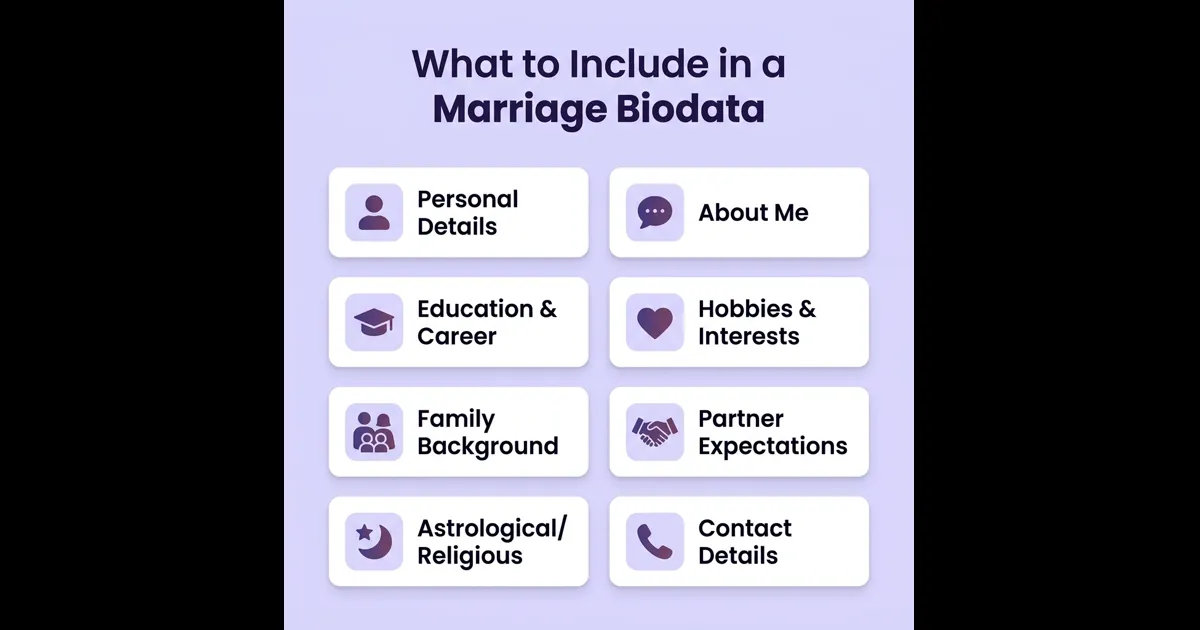
When creating a profile for arranged marriage, knowing what to include in a marriage biodata is the single most important factor between getting responses and getting ignored. Families receive dozens of profiles every week — one with a missing income field, a blank family section, or no About Me paragraph is immediately set aside. This field-by-field guide fixes that.
Whether you are creating your first marriage biodata or updating an existing one, this guide tells you exactly what to write in each section — with real sample text, common mistakes to avoid, and community-specific notes for Hindu, Muslim, and Christian families.
Skip the guesswork — build with the right fields already in place.
BiodataBuilder’s free creator has dedicated fields for every section in this guide — no formatting needed.
1. Personal Details
This is the opening block of every biodata. Families read it first to establish a basic demographic match before reading anything else.
| Field | What to Write | Common Mistake |
|---|---|---|
| Full Name | Legal name as on official documents | Avoid nicknames or initials only |
| Date of Birth | DD/MM/YYYY format (e.g., 15 March 1997) | Do not use just the year — families need the full date for Kundali |
| Time of Birth | As accurately as possible (e.g., 6:45 AM) — check your birth certificate | Leaving this blank forces the family to ask, delaying the process |
| Place of Birth | City and State (e.g., Nashik, Maharashtra) | Do not write just the country |
| Height | In feet and inches (e.g., 5 ft 6 in) | Avoid rounding up — families notice at the first meeting |
| Blood Group | A+, B-, O+, etc. | Optional but recommended — useful in family emergencies |
| Complexion | Fair / Wheatish / Dusky (optional) | Only include if your community expects it — many modern families skip it |
| Marital Status | Unmarried / Divorced / Widowed | Never leave blank — it is the most fundamental filter |
Note on Complexion: Including complexion in a biodata is a personal and cultural choice. Many urban and progressive families now skip it entirely. If in doubt, leave it out — no family will reject a profile because complexion was not listed.
2. Education & Career
This section is where families assess your stability and ambition. List your highest qualification first, then your current job. Be specific — vague entries like “working in IT” or “good job” are red flags, not reassurances.
How to List Your Education
Always write: Degree Name, Specialisation, Institution, Year of Completion.
Avoid This
- “B.Tech from a reputed college”
- “MBA (pursuing)” — (if completed, say completed)
- “Qualified engineer”
Write This Instead
- B.Tech (Computer Science), IIT Delhi, 2019
- MBA (Finance), Symbiosis Pune, 2021
- CA (ICAI), Final cleared Nov 2022
How to List Your Occupation
| Field | What to Write |
|---|---|
| Job Title | Senior Software Engineer / Assistant Manager / Chartered Accountant |
| Company / Employer | TCS, Infosys, HDFC Bank — or "Self-employed (Family Business: Textiles)" |
| Work Location | City where you currently work (e.g., Bengaluru, Pune) |
| Years of Experience | 5 years / 3 years (optional but helpful for mid-career profiles) |
| Annual Income | ₹12–15 LPA or ₹45,000/month — always a range, never a vague answer |
For government employees, also mention the grade/scale (e.g., “IAS Officer, Joint Secretary level”). For business owners, mention the nature of business and number of years established. For more guidance, see our biodata format guide.
3. Family Background
In Indian arranged marriages, the family section is often read before the candidate's personal details. Families want to understand your roots, social standing, and upbringing. A sparse family section signals that you are hiding something.
| Field | What to Write |
|---|---|
| Father's Name | Full name + current occupation (e.g., "Ramesh Sharma — Retired Government Officer") |
| Mother's Name | Full name + occupation. "Homemaker" is a perfectly valid and respected answer. |
| Brothers | List each: name, age, marital status, profession. E.g., "Elder brother Raj (32, Married, Software Engineer at Wipro)" |
| Sisters | Same format as brothers. If married, mentioning spouse's profession adds transparency. |
| Native City / State | Where the family is originally from (e.g., "Originally from Varanasi, UP — currently residing in Mumbai") |
| Family Type | Joint / Nuclear — important cultural signal for conservative families |
Sample Family Section (formatted)
Father: Suresh Mehta — Retired Bank Manager (SBI)
Mother: Anita Mehta — Homemaker
Brother: Nikhil Mehta (28) — Unmarried, B.Tech, works at Infosys, Pune
Sister: Priya Mehta (32) — Married, MBA, works at HDFC Bank, Mumbai
Family: Joint family, originally from Ahmedabad — currently in Pune
For community-specific expectations (e.g., listing maternal uncle for North Indian families), see our Hindu biodata guide. For second marriage biodatas, the family section needs a specific approach — read our second marriage biodata guide.
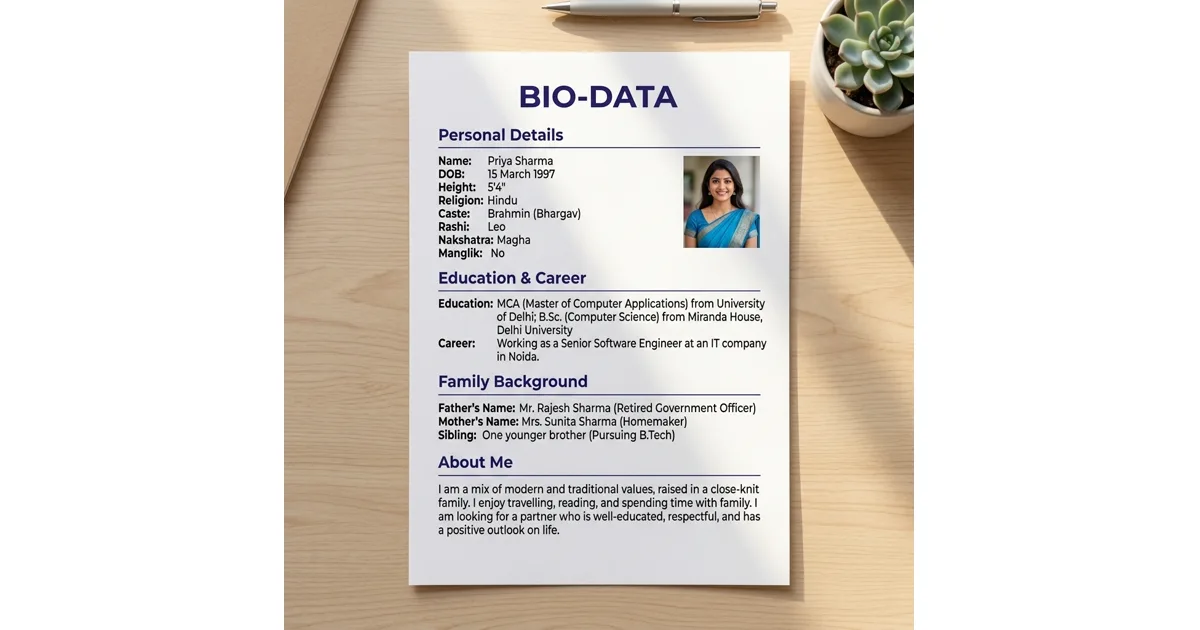
4. Astrological & Religious Details
What goes in this section depends entirely on your community. For Hindu families it is the most critical section of the biodata — many families check it before reading anything else. For Muslim and Christian families, a shorter religious identity block replaces the full astrological section.
| Community | Required Religious Fields |
|---|---|
| Hindu | Rashi (Moon Sign), Nakshatra & Pada, Gotra, Manglik Status (Manglik / Anshik / Non-Manglik), Date + Time + Place of Birth. Optional: Gana, Nadi, Lagna. |
| Muslim | Religion, Sect/Maslak (Sunni/Shia), degree of religious practice. Horoscope matching is generally not practiced. |
| Christian | Denomination (Roman Catholic / CSI / Pentecostal / etc.), Church/Parish name, Baptism status, Confirmation status (for Catholics). |
| Sikh | Religion: Sikh, Gotra (some families include it), whether Amritdhari (initiated), native state. |
| Jain | Sect (Digambar / Shwetambar), dietary preference (Jain Veg), Paryushan/festival observance. |
Hindu families: Never guess your Gotra or Nakshatra — an incorrect Gotra can accidentally result in a same-Gotra match being approved, which will be cancelled later. If unsure, write “To be confirmed” rather than guessing. For a full breakdown of each astrological field, see our Kundali details guide and Manglik biodata guide.
5. The “About Me” Section
This is the only free-text section in a biodata — and the one that makes families pick up the phone. A generic About Me is worse than leaving it blank, because it actively signals low effort.
❌ Generic (Avoid)
“I am a simple, family-oriented person who loves to enjoy life and is looking for a life partner.”
✅ Specific (Use This)
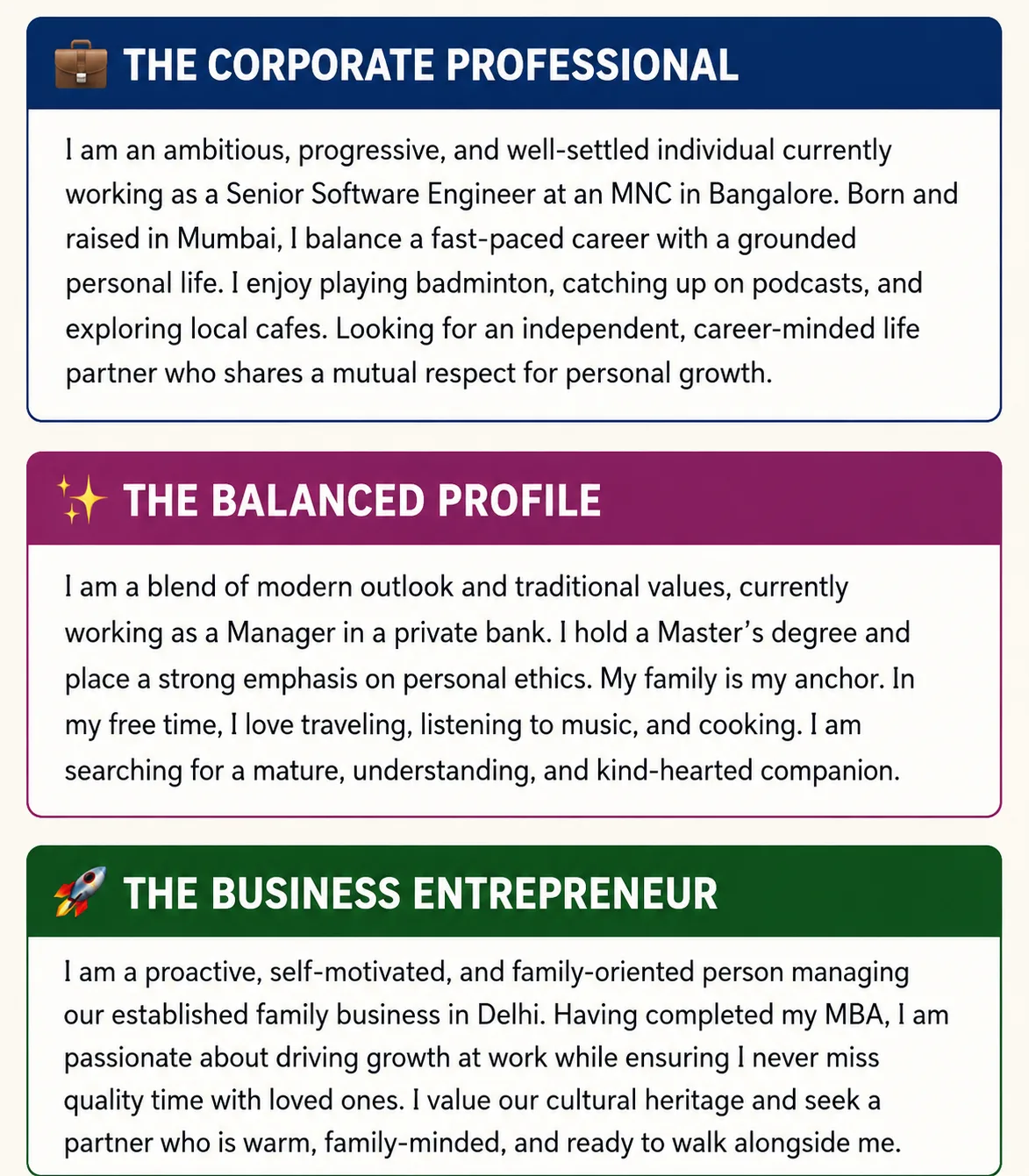
“A software engineer at Infosys, Bengaluru, raised in a close-knit Tamil Brahmin family. I train for half-marathons and read Indian history. I am looking for a partner who values both career ambition and family time.”
Rule: 4–6 sentences covering your profession, one cultural or personal detail, your values, and what you are looking for in a partner. For a full step-by-step guide with 6 ready-to-use examples, read our complete About Me writing guide.
Already know what to write?
Use BiodataBuilder’s free templates — every field in this guide is pre-structured. Fill in your details, download a PDF, and share on WhatsApp in minutes.
6. Hobbies & Interests
Hobbies are conversation starters. A shared interest is frequently the reason a family decides to call. Write 3–5 hobbies — and make them specific enough to be memorable.
| ❌ Generic (Avoid) | ✅ Specific (Write This) |
|---|---|
| Listening to music | Learning Hindustani classical vocals (6 years) |
| Watching movies | Curating Tamil New Wave cinema and attending film festivals |
| Cooking | Baking eggless desserts and experimenting with regional recipes |
| Travelling | Solo trekking in the Himalayas (completed 3 treks) |
| Reading books | Reading Indian economic history and contemporary policy |
7. Partner Expectations
People make two opposite mistakes here: writing nothing, or writing a rigid 15-point checklist. Both hurt your chances.
- 1.Keep it to 2–3 expectations — not a checklist. Long lists are off-putting.
- 2.Write positively — “Looking for an educated, kind partner” beats a list of prohibitions.
- 3.State hard requirements clearly — if denomination, diet, or city truly matters, say so upfront to save everyone's time.
Sample that gets it right:
“Looking for an educated, employed partner who values both family and personal growth. Open to different cities. Caste no bar for the right person.”
For in-depth guidance on phrasing, see the Partner Expectations section in our expert tips guide. Also note that modern biodatas increasingly frame expectations as preferences rather than requirements.
8. Contact Details
Always end your biodata with a clear contact block. For WhatsApp sharing, your phone number is mandatory — make it easy for the other family to reach you without searching.
| Field | Guidance |
|---|---|
| WhatsApp Number | State clearly whose number it is — e.g., "Father's WhatsApp: +91 98XXX XXXXX" |
| Email Address | One address is enough. Use a personal email, not a work address. |
| Residential City | Current city of residence (e.g., Bengaluru, Karnataka). |
| Full Address | Optional — sharing the full postal address on a widely distributed biodata is a privacy risk. City + state is sufficient. |
Privacy: Never include Aadhaar number, PAN, or bank details in a biodata. For women, sharing a parent's number as the primary contact first is a common and sensible practice.
Optional Fields (Community-Specific)
The 8 sections above are mandatory for all communities. These additional fields are expected only in specific communities or situations. Do not add them just to fill space — the entire biodata must fit on one page.
| Optional Field | Who Should Include It |
|---|---|
| NRI / Visa Status | Anyone working abroad — include country, visa type (H-1B, PR, Citizen), and plans to return to India. |
| Dietary Preference | Mandatory if Jain Veg. Strongly recommended for strictly vegetarian families (Brahmin, Vaishnav, Agarwal). Otherwise optional. |
| Native Village / Ancestral Town | North Indian (UP, Bihar, Rajasthan) and Rajput families — verifies lineage and Biraderi. |
| Languages Spoken | Useful for cross-regional matches (e.g., Tamil-speaking family seeking matches in Maharashtra). |
| Property / Assets | Rajput, Jat, and land-owning communities in North and Western India often include agricultural land holdings. |
| Physical Disability | Mention only if it is directly relevant to practical aspects of the marriage. Handle with dignity and directness. |
3 Pro Tips Before You Finalise
- Print and read it aloud — errors you miss on screen are obvious when heard. Have a parent or sibling review it too.
- Keep it to one page — if it overflows, cut the optional fields first, then shorten the About Me paragraph. Never cut income or family.
- Save as PDF before sharing on WhatsApp — a Word document loses formatting when opened on different phones. PDF looks identical on every device.
Common Mistakes to Avoid
- Leaving income blank
Families read a blank income field as evasion, not modesty. State a range — even ₹X to ₹Y LPA. If you are a fresher, write ₹0 (Fresher) rather than nothing.
- Using degree abbreviations the family won't recognise
"PGDM" means nothing to many families. Write "Post Graduate Diploma in Management (equivalent to MBA), Symbiosis Pune." Spell it out.
- Writing just 'IT Professional' as occupation
No family can match on 'IT Professional'. Write the actual job title: Senior Backend Engineer, Product Manager, Data Analyst.
- Guessing astrological details
If you are unsure of your Nakshatra or Gotra, write 'To be confirmed' rather than guessing. An incorrect Gotra can derail a match at a very late stage.
- Not stating whose contact number is listed
Write 'Candidate's WhatsApp' or 'Father's mobile' explicitly. Ambiguity creates an awkward first call.
- Going beyond one page
A biodata is not a CV. Every family receives dozens of profiles. A clean, focused one-pager always outperforms a cluttered two-pager.
Ready to Build Your Biodata?
BiodataBuilder has dedicated fields for every section in this guide — personal details, kundali, family, About Me, and more. Download your PDF in minutes. Free, no sign-up.
Create Biodata FreeFrequently Asked Questions
What should be included in a marriage biodata?
A complete marriage biodata includes: personal details (name, DOB, height), education and career (degrees, job title, income), family background (parents, siblings), astrological or religious details (community-dependent), an About Me paragraph, hobbies, partner expectations, and contact details.
How do I write education qualification in a marriage biodata?
List your highest degree first: Degree Name, Specialisation, Institution, Year. For example: B.Tech (Computer Science), IIT Delhi, 2019. Avoid vague entries like 'from a reputed college' — be specific.
Should I include occupation and income in a marriage biodata?
Yes — always. Include your job title, company name, work city, and annual income as a range (e.g., ₹12–15 LPA). Leaving income blank is one of the most common reasons a biodata gets ignored.
What details go in the family background section?
Father's name and occupation, mother's name and occupation (homemaker is valid), brothers and sisters with their age, marital status, and profession, plus the family's native city or state and family type (joint or nuclear).
What astrological details should I include?
For Hindu families: Rashi, Nakshatra & Pada, Gotra, Manglik Status, and Date + Time + Place of Birth (for Kundali casting). For Muslim families: Sect/Maslak. For Christian families: Denomination, church name, and baptism status.
Should I mention complexion in a marriage biodata?
It is optional and increasingly skipped in modern biodatas. Include it only if your community explicitly expects it. No family will reject a profile because complexion was absent.
Conclusion
A strong marriage biodata covers 8 mandatory sections — Personal Details, Education & Career, Family Background, Astrological/Religious Details, About Me, Hobbies, Partner Expectations, and Contact Details. Beyond those, add optional fields only if your community specifically expects them, and keep the entire document to one page.
The easiest way to ensure nothing is missed is to use a builder with all these sections pre-structured. BiodataBuilder has professionally designed templates with dedicated fields for every section in this guide — fill in your details, pick a template, download a print-ready PDF, and share it directly on WhatsApp in minutes. Free, no sign-up required.
What to Read Next
Ready to create your biodata?
Use our free builder to make a WhatsApp-ready marriage biodata PDF in minutes.
Open free biodata maker