Rajan Kumar
Founder, BiodataBuilderRajan built BiodataBuilder to help millions of Indians create professional marriage biodatas easily. With expertise in Indian matrimonial traditions and 2M+ biodatas created on the platform, his guides cover every regional format, community custom, and modern best practice.
Last Updated:
Gotra & Caste in Marriage Biodata — When & How
Families still ask about gotra, caste, and subcaste in many Indian matchmaking circles. Here is a practical, respectful guide to when to include them, how to write them, and when they can stay optional.
TL;DR
- Include gotra/community when elders or the matchmaking channel require them; leave blank if your search is open and optional.
- Write factual labels only — never demeaning or ranking language about any community.
- Pair with kundali fields when needed, then build a clean PDF in the free biodata maker.
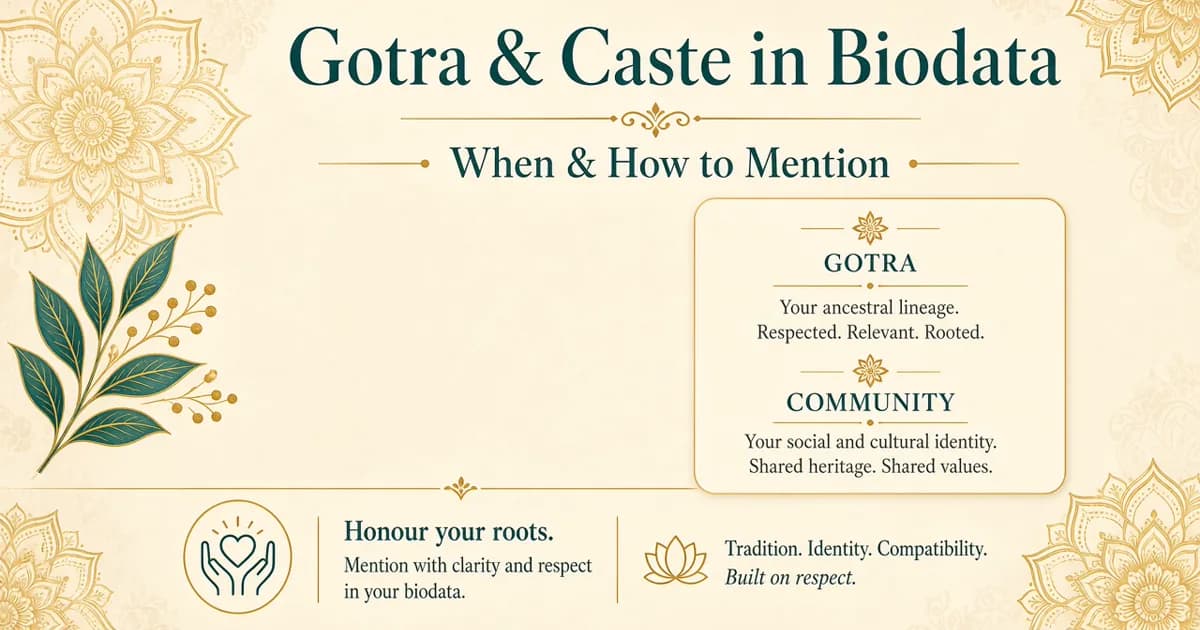
Start from a clear biodata format, decide what to include, and see full biodata for marriage structure before filling community fields.
Add gotra and community fields, then export a one-page PDF free.
Open makerWhat gotra, caste & subcaste mean in biodata
In a marriage biodata context, these labels are information fields — not judgments. Families use them as filters or conversation starters; your job is to be accurate and respectful.
- Gotra: A traditional lineage name (often patrilineal). Many Hindu families avoid matches within the same gotra. Confirm spelling with elders.
- Caste / community: The broader community identity used in regional matchmaking (wording varies by state — caste, community, or samaj).
- Subcaste / upjaati / gotra-samaj detail: A finer label some circles still ask for. Include only if your family or broker uses it.
| Field | Example | When to include |
|---|---|---|
| Gotra | Bharadwaj / Kashyap | Hindu (and some Sikh/Jain) lineage checks |
| Community / caste | Agarwal / Kayastha | When brokers or elders filter by community |
| Subcaste | Srivastava · — | Only if your circle still asks |
| Unknown gotra | To be confirmed | Better than guessing |
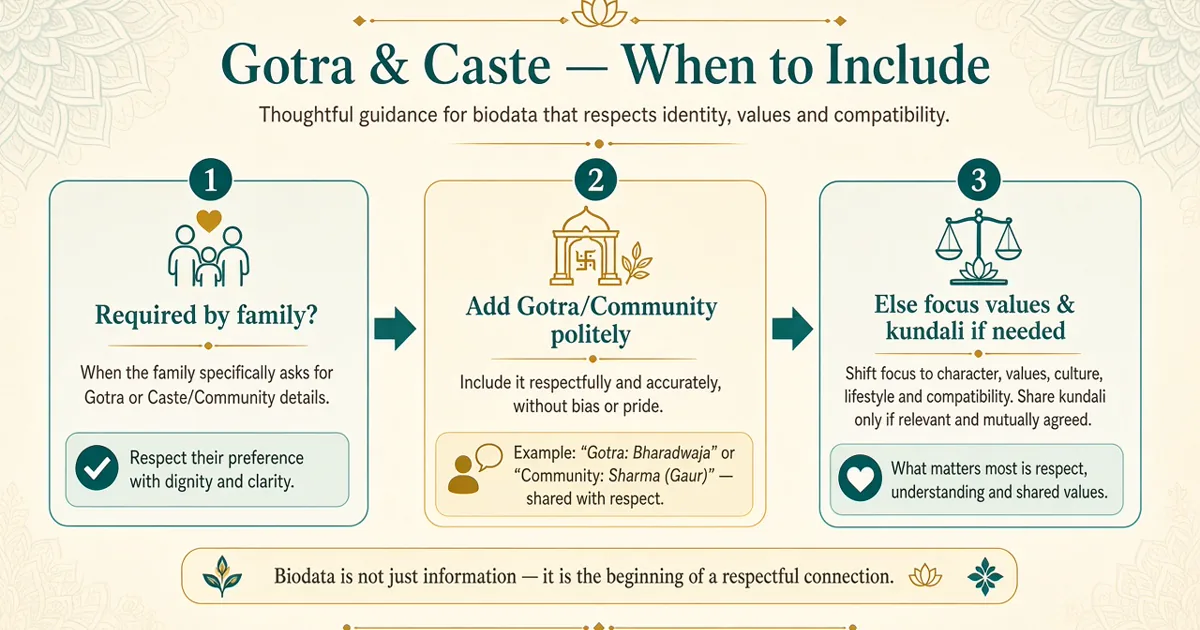
For Hindu layouts that bundle these with religion and rituals, see best marriage biodata format for Hindu and biodata sample for marriage.
When families usually require them
Requirements differ by region, generation, and channel (family WhatsApp, community matrimony, or open apps). Typical patterns:
- Traditional arranged searches often expect community + gotra early.
- Same-community brokers may ask subcaste even if apps hide it.
- Inter-community or modern searches may treat caste as optional; gotra may still appear for kundali-focused families.
Compare tone with modern vs traditional biodata — traditional PDFs list community clearly; modern ones lead with education and values.
When families insist vs when these fields stay optional
Treat gotra and community as process tools, not moral scores. Some households will not forward a profile without them; others barely glance. Knowing which side you are on saves awkward WhatsApp threads later.
When families usually insist
- Same-community searches through relatives or a neighbourhood broker — e.g. looking for a match for Priya Sharma within Kayastha families in Lucknow — almost always ask community + gotra in the first message.
- Elders who still do same-gotra avoidance will pause a match between two Bharadwaj profiles until someone confirms the gotras carefully, even if education and city look perfect.
- Matrimonial websites and community WhatsApp groups often have filters; your PDF should match what you ticked online so nobody feels misled.
- Kundali-focused households may want gotra on the same page as Rashi and Manglik so one PDF answers both lineage and chart questions. See kundali details in biodata.
When they can stay optional
- You and your parents have agreed to consider inter-community matches and prefer leading with city, education, and values.
- You are sharing mainly with peers (colleagues, college friends) who filter on lifestyle more than samaj labels.
- Your community rarely uses gotra in practice — forcing a blank field to invent a value helps no one.
Optional on the PDF does not mean rude in private. If an aunt asks "What is his gotra?" for Arjun Mehta, answer calmly with whatever you choose to share — or say you will confirm with elders — rather than arguing ideology on a family group.
How to write gotra & caste politely
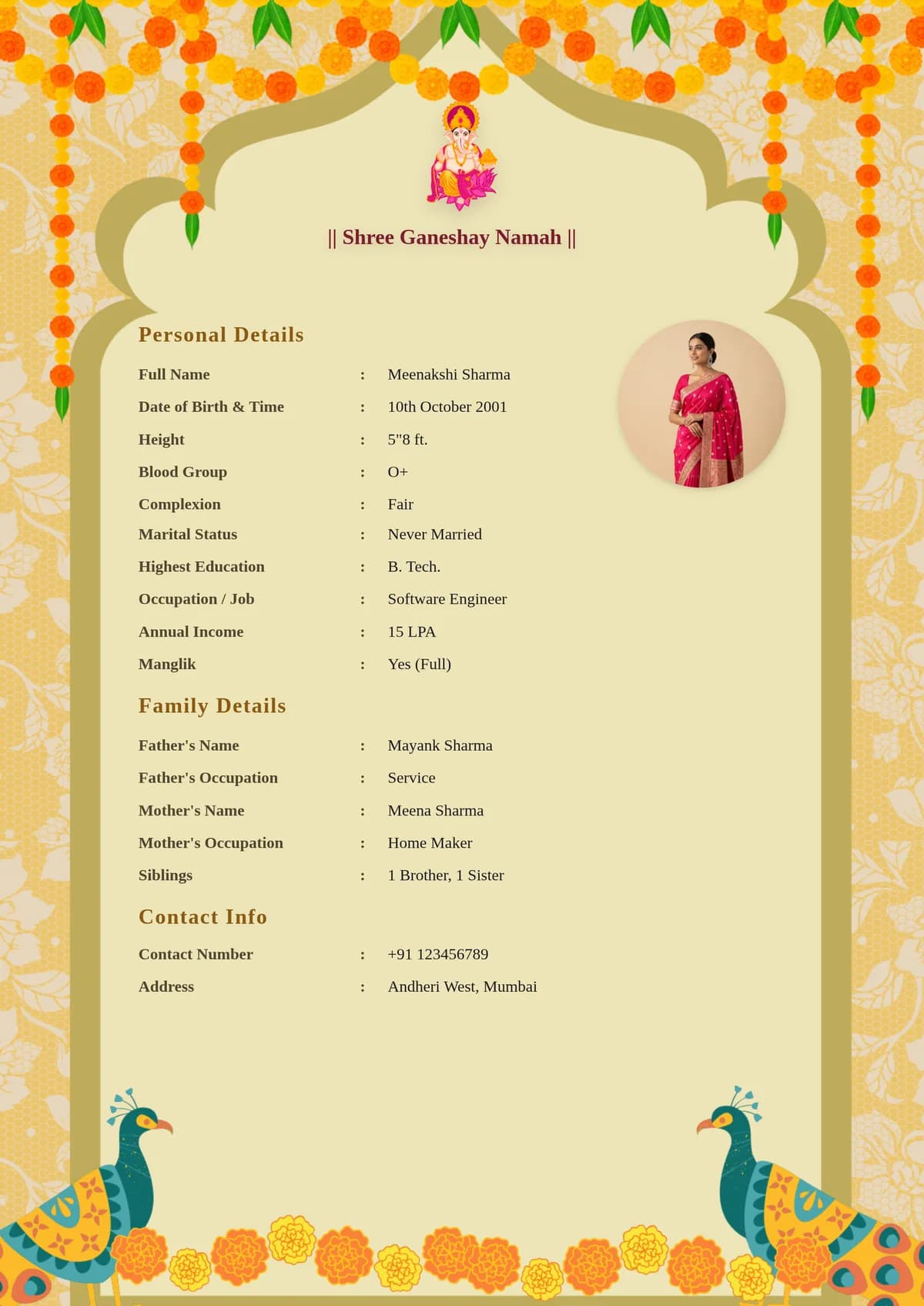
Use short, neutral lines. Examples of clear phrasing:
- Religion: Hindu · Community: Brahmin · Gotra: Bharadwaj
- Community: Agarwal · Gotra: Garg · Subcaste: —
- Gotra: Kashyap (confirmed with family)
Avoid phrases that rank communities, demand exclusion in insulting words, or mix personal bias into the field. Preference filters belong in a calm partner expectations section — still without hate or demeaning language.
Subcaste & community spelling tips
Spelling inconsistency is a quiet trust killer. A broker searching "Srivastava" may miss "Shrivastava" or "Srivasthava" if your PDF uses a one-off spelling. Pick the form your elders and community documents already use, then stick to it on every channel.
- Ask once, write once: Confirm with parents or grandparents before you publish. For example, if family says gotra is Kashyap, do not switch to Kashyapa on LinkedIn-style bios and a different spelling on the matrimony form.
- Match regional labels: Some states say "caste," others "community" or "samaj." On a one-page PDF, "Community: Marwari Agarwal" is clearer than mixing three synonyms.
- Subcaste only when used: If your circle never asks for upjaati, leave the line blank. Filling "N/A" or inventing a finer label looks odd and can start unnecessary debate.
- Avoid creative English: Do not translate gotra into explanatory essays ("sage lineage of…"). A single accurate word is enough for biodata format readers who already know the term.
Sample consistent block for Sneha Gupta: Religion: Hindu · Community: Kayastha · Subcaste: Srivastava · Gotra: Bharadwaj. Same spelling on the PDF, WhatsApp caption, and any broker sheet.
Intercaste biodata wording (clear and calm)
If you are open to inter-community matches — or already expect interest across communities — say so without apology speeches and without sounding dismissive of families who still prefer same-community searches.
- Lead with education, city, and family values; keep community factual if you list it: "Community: Hindu — open to inter-community matches with mutual respect."
- Put openness in partner expectations rather than deleting community and hoping people guess: "Comfortable with inter-community proposals; family prefers educated, family-oriented partner."
- If one side of the family still filters by community while you personally do not, be honest: "Parents prefer same community; open to discuss strong matches otherwise." That line prevents wasted calls.
- Never write put-downs of any community as "openness." Intercaste wording should widen the door, not insult people who walk a different path.
For layouts that still need a neat one-pager, start from a simple one-page marriage biodata and keep the intercaste note to one short sentence.
Handling "caste no bar" on biodata
"Caste no bar" is common on matrimony sites. On a personal PDF it can help — or confuse — depending on how you write it.
- If you truly mean it: Write "Community preference: Open (caste no bar)" in expectations, and still list your own community factually if elders want it on record. Example for Rohan Verma: Community: Agarwal · Partner preference: Caste no bar; values education and mutual respect.
- If parents disagree: Do not put "caste no bar" on a PDF your parents will forward to same-community brokers. Maintain two sharing modes — open PDF for peer networks, fuller community PDF for traditional channels — without changing facts, only emphasis.
- If you mean religion-open but community-specific: Say that clearly. "Caste no bar" is not the same as "any religion." Vague slogans create mismatched rishtas.
Pair this with calm expectations language from what to include in marriage biodata so openness does not crowd out education and family basics.
Sikh, Jain, Christian & other light notes
Practices vary by family and region. These notes are practical only — not prescriptions. Ask elders what your circle actually uses, then leave unused fields blank rather than inventing Hindu-style gotra lines.
- Hindu: Gotra + community are common; pair with Rashi/Nakshatra when families do kundali matching. See the Hindu biodata format.
- Sikh: Some families list gotra or clan; others emphasise family background, Gurdwara community, and values. A profile for someone like Gurpreet Singh might show Religion: Sikh · Family: Amritsar / Delhi · Gotra: (if used) — or simply omit gotra if elders do not use it.
- Jain: Digambar/Shwetambar and regional samaj often matter more than gotra. Confirm whether your family writes community as "Jain — Shwetambar" or a local samaj name, and keep dietary/values notes brief if relevant to your circle.
- Christian: Many biodatas skip caste entirely and focus on denomination (if the family uses it), parish or city church community, education, and family. Do not paste empty "Gotra:" rows that signal a mismatched template.
- Muslim: Structure differs — focus on clear personal and family sections. Use marriage biodata format for Muslim rather than forcing Hindu gotra fields. Some regions mention biradari; many do not.
Community design templates (for example a Punjabi biodata format) are fine when the fields match lived practice.
When these fields are optional
Leaving caste blank is reasonable if you are open to inter-community matches, sharing mainly with peers who filter on education/city, or your family has agreed not to use that filter. Still answer relatives privately if they ask — silence can look like avoidance.
Optional does not mean inaccurate: never invent a gotra to look complete. Prefer "to be confirmed" or omit the line. For citizen-facing context on community and identity services in India, see India.gov.in — keep government IDs off any widely shared biodata.
Linking gotra to kundali without oversharing
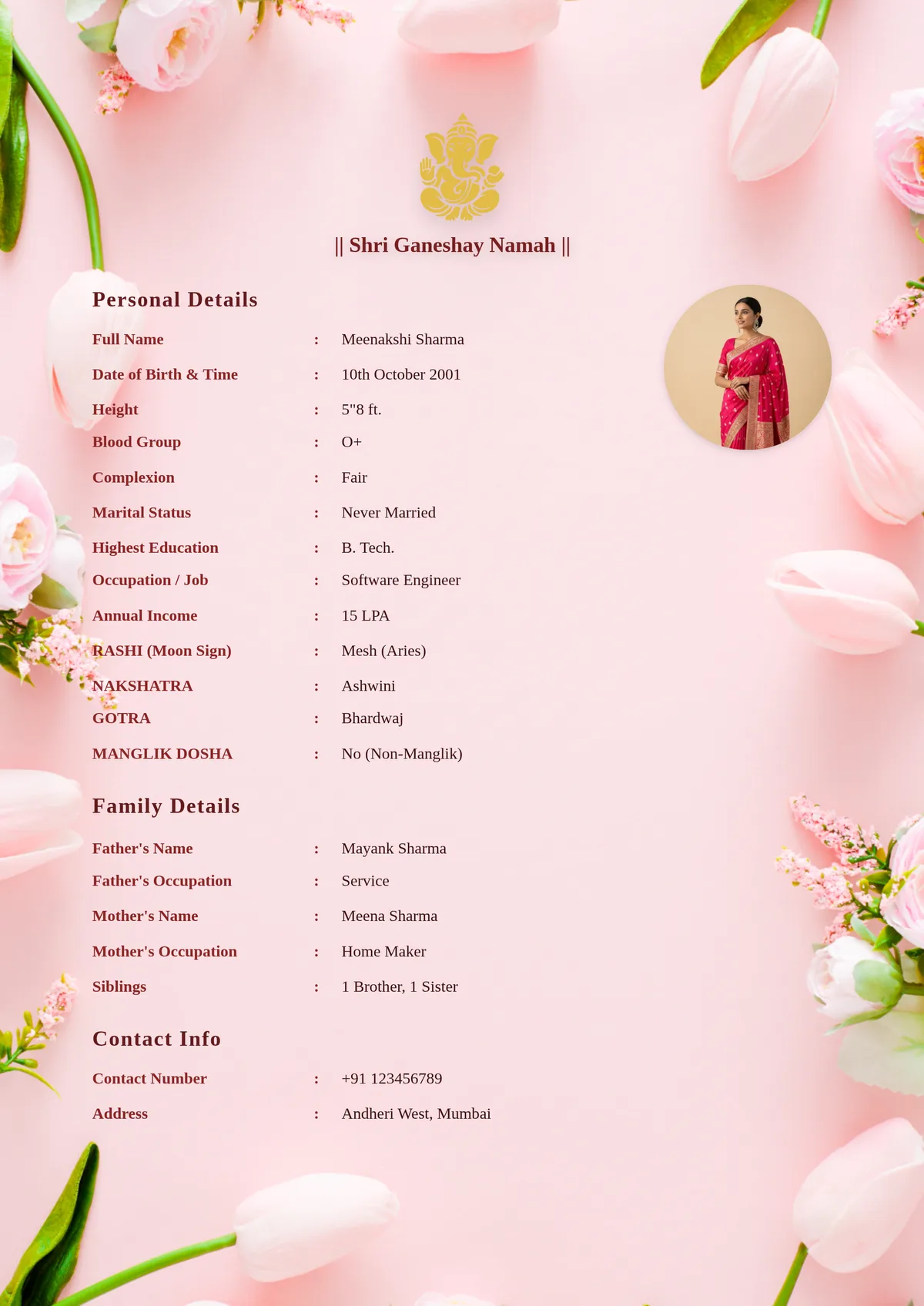
Gotra is lineage; kundali fields (birth date/time/place, Rashi, Nakshatra, Manglik) are chart details. Many Hindu PDFs show both in one compact block so families can run gotra checks and Guna Milan together — without attaching a full scanned kundali chart to every WhatsApp forward.
- On the biodata: Gotra, Rashi, Nakshatra, Manglik (Yes/No/Partial as your family states), and birth place/time if you are comfortable sharing.
- Off the biodata until asked: full chart PDFs, long dosha essays, or priest notes. Share those after mutual interest so a widely forwarded file does not carry more than needed.
- If birth time is uncertain, write "approx." or "to be confirmed" rather than inventing a minute that later fails matching.
Deep dives: kundali details in biodata · manglik biodata format · biodata for marriage.
Sample polite lines you can copy
Use these as templates — swap names and labels for your family. Keep each to one line on a biodata sample.
- Religion: Hindu · Community: Brahmin · Gotra: Bharadwaj (confirmed with family).
- Community: Kayastha · Subcaste: Srivastava · Gotra: Kashyap.
- Gotra: To be confirmed with elders before final talks.
- Community listed for family reference; open to respectful inter-community proposals.
- Partner preference: Same community preferred by parents; education and values matter equally.
- Caste preference: Open (caste no bar) — seeking a kind, family-oriented partner.
- Religion: Sikh · Family from Ludhiana; gotra used in our circle: [clan] / not applicable.
- Kundali: Rashi Kanya · Nakshatra Hasta · Manglik: No · Gotra: Garg — full chart on request.
Broker filters vs your personal PDF
Brokers and community portals often need structured caste/gotra filters. Your personal PDF is what relatives forward on WhatsApp. Align the facts; you may still vary the emphasis.
- Broker sheet: Fill every filter they use (community, subcaste, gotra, manglik) accurately so you are not dropped from searches. Wrong gotra here wastes everyone's time.
- Personal PDF: Keep the same spellings, but you can lead with education and career for a more modern vs traditional feel, with community in a compact row.
- Do not run conflicting stories: If the broker lists community A and your PDF says "caste no bar" with community blank, relatives will ask which is true. Same facts, different layout is fine; different facts are not.
Build the personal PDF in the free biodata maker so you can export a clean one-pager after filling community fields once.
Mistakes that offend (and how to avoid them)
Most offence comes from tone, not from listing a community. Keep labels factual and expectations respectful.
- Ranking language — "upper/lower," slang names, or jokes about any community
- Demanding a partner's caste in harsh words inside partner expectations
- Guessing someone else's gotra in a group chat "to help" — never do this
- Publishing a wrong gotra because a cousin "thought it was X"
- Using Hindu gotra rows on templates for families that do not use them
- Lecturing relatives in the biodata PDF about why caste is wrong — keep the biodata factual; save opinions for private talks
For contact privacy when PDFs travel widely, also see biodata contact details & privacy.
Practical answers families ask (beyond the FAQ)
These situations come up often in Indian matchmaking chats. Short, steady replies work better than long debates.
Same gotra came up late
If two families discover a same-gotra issue after liking education and photos, pause politely: confirm both spellings with elders, then follow your family's custom. Updating the PDF so gotra is visible early prevents this surprise. Do not accuse anyone of hiding facts unless there is clear intent — often it was simply never written.
Relatives pressure you to invent a gotra
Refuse gently. A guessed gotra for someone like Ankit Joshi can collapse trust at the engagement stage. Write "to be confirmed" and call grandparents. Accuracy beats a filled box.
You want privacy but brokers want filters
Share full community details with the broker under the understanding that they circulate only to relevant families. On public or large WhatsApp forwards, keep a shorter PDF with community optional — same person, different audience. Tips for trimming: biodata tips.
Intercaste interest, same-gotra family on one side
State both facts early: your openness and any hard filters elders still hold. A clear sentence saves weeks of mixed signals. Keep the shaadi biodata format for girl or marriage biodata for boy structure intact so the profile still looks complete.
Pro tips for gotra & caste
- Confirm gotra spelling with elders before publishing — wrong gotra destroys trust.
- Write factual community labels only; never use ranking or demeaning language.
- Leave caste blank when your search is open; answer relatives privately if they ask.
- Use a free BiodataBuilder template, then export a one-page PDF for WhatsApp.
- Pair gotra with compact kundali fields only when your family process needs both.
Common mistakes
- Guessing gotra instead of marking "to be confirmed"
- Using slang or ranking language about any community
- Forcing Hindu gotra fields onto Muslim or other formats that do not use them
- Leaving kundali blank when elders clearly expect Rashi/Manglik alongside gotra
- Filling every optional box just to look complete
Pre-send checklist
- Gotra confirmed with elders (or marked 'to be confirmed')
- Community/caste phrased factually — no ranking language
- Subcaste included only if your circle uses it
- Religion-specific fields match family norms (Hindu/Sikh/Jain/other)
- Kundali / Manglik fields filled if the process needs them
- Optional fields left blank rather than guessed
- Tone respectful; fits on one PDF page
Build a respectful PDF biodata
Fill community and kundali fields only as needed — then share on WhatsApp.
Create free biodataFAQ
What is gotra in a marriage biodata?
Gotra is a traditional patrilineal lineage label used mainly in Hindu (and some Sikh/Jain) matchmaking. Families often check it for same-gotra avoidance rules. Write the exact gotra your elders confirm — do not guess.
Is caste mandatory in marriage biodata?
Not always. Many traditional families still expect community/caste and sometimes subcaste. Modern or inter-community searches may leave caste blank or mark it optional. Follow what the sharing channel (family, broker, app) actually asks for.
How should I write caste and subcaste politely?
Use factual labels only (e.g., Community: Kayastha · Subcaste: Srivastava). Avoid ranking language, slang, or comments about other communities. Keep one short line.
Do Sikh and Jain biodatas need gotra?
Some Sikh and Jain families use gotra or clan/lineage fields; others focus on family background and values. Ask elders what is customary in your circle. If unused, leave blank rather than inventing a value.
Should Muslim marriage biodatas list caste?
Practices vary by region and family. Some profiles mention biradari or community; many do not. Prefer religion, sect/fiqh if relevant, and family background. See a dedicated Muslim biodata format guide for structure.
How do gotra and kundali details connect?
Gotra sits beside Rashi, Nakshatra, and Manglik status in many Hindu biodatas. Birth details help cast a kundali; gotra is lineage, not a planet. Include both when the family process uses both filters.
What if I do not know my gotra?
Ask parents or grandparents before publishing. If still unknown, write 'Gotra: To be confirmed' rather than an incorrect guess. Wrong gotra creates distrust later.
Can I omit caste for a modern biodata?
Yes if you are sharing in circles that do not filter by caste, or you explicitly want value/education-first matching. Be ready for some relatives or brokers to ask anyway — reply calmly with whatever you choose to share.
Where do I add gotra and community in a free PDF biodata?
Use BiodataBuilder.in — fill personal and religious/community fields, add kundali details if needed, then download a one-page PDF for WhatsApp.
Conclusion
Treat gotra and caste in a marriage biodata as factual fields shaped by family and regional norms — include them when required, keep wording polite, and skip or mark optional when your search is open. Accuracy and respect matter more than filling every box — then add them in a free PDF biodata template and share on WhatsApp.
What to Read Next
Ready to create your biodata?
Use our free builder to make a WhatsApp-ready marriage biodata PDF in minutes.
Open free biodata maker